Memai
Memai is an ERAM eau de parfum with green tea at its center. Green tea, bergamot and lemon open brightly, peony, muguet and magnolia follow, and cedarwood and vetiver settle it into calm wood and earth. It is at its best on spring and summer days and suits any gender.
#499 · 2026-09-30
Fragrance Overview and First Impressions
Memai is a perfume by ERAM, a Japanese fragrance brand that grew out of the cosmetics group POLA ORBIS HOLDINGS. ERAM takes its name from eramu, an old Japanese word meaning “to choose,” reflecting the way the brand invites people to choose scents through images and words. Within the lineup, Memai puts green tea at the center. It is reported to have been released in 2024, and it comes as a 30 ml eau de parfum.
The name means “dizziness” in Japanese, which might suggest something heady and overwhelming. Instead, the first spray brings green tea layered with bergamot and lemon, a bright scent with little sweetness. The brand calls this opening pure and graceful, and describes the whole as the delicate, multilayered aroma of tea. It carries no official fragrance family name.
Each ERAM fragrance comes with a short poem. Memai's reads: “Those feelings that once came from across the sea have, before I knew it, become a part of me.” Starting with bright green tea and ending in calm wood and earth, the scent gathers weight as it goes.
Perfumer, Brand Background and Making-of
The brand does not publish the name of an individual perfumer, while a retailer credits Shigeo Kishida as the perfumer of Memai. Describing the green tea, the brand explains that the perfumer created an imagined tea scent from natural and synthetic materials. Because green tea smells different in Japan and elsewhere, the note is built as an image of green tea rather than a copy of any one country's brew.
Across the whole ERAM range, Takashi Sato serves as fragrance supervisor and scent adviser. He spent more than 40 years at POLA developing fragrances for cosmetics and perfumes, and he is a full member of the French Society of Perfumers.
The brand began through the in-house venture program of POLA ORBIS HOLDINGS. In July 2023 it launched as a perfume subscription designed to help people find scents they like. The head of the business later recalled realizing that customers' tastes were all over the place, and that the team's own assumptions had been rigid. On November 1, 2024, ERAM relaunched as a brand selling its own perfumes, with 16 fragrances; the official site now lists 17.
Brand production is handled by the creative agency CEKAI, with art direction, design and artwork by the design team heso. CEKAI clearly remembers the moment the brand first said it wanted to create a world without color. Color fixes how a scent is imagined, so the idea was to let people imagine freely from an ambiguous, colorless world. That is why ERAM's artwork is monochrome.
ERAM's fragrances are described as drawing on classical literature to express scenes and feelings that resonate with Japanese sensibilities, each assigned a concept in the form of a short poem inspired by the Hyakunin Isshu anthology. Which poem inspired Memai has not been revealed. The brand expresses a Japanese character through the structure of each blend rather than through overtly traditional materials, and production is said to take place in the Yatsugatake area of Nagano, more than 1,000 meters above sea level.
Scent Analysis
The top notes are green tea, bergamot and lemon. The tea is joined by the soft bitterness of bergamot, the citrus used to flavor Earl Grey, and the tartness of freshly squeezed lemon peel. The result is a bright, low-sugar opening that the brand says reflects each shining moment of life. Both the name and the brand's own description center on this moment when tea and citrus meet.
The heart brings peony, muguet and magnolia. Peony, the flower known in Japan as shakuyaku, adds soft fullness; muguet, the French name for lily of the valley, adds clean clarity; and magnolia, a relative of the Japanese mokuren, contributes a citrus-like brightness. Layered over the tea and citrus, these three flowers form what the brand calls an elegant, radiant floral layer.
The base is cedarwood, sandalwood and vetiver. Cedarwood is a conifer scent the brand describes as a fresh, spicy wood, while sandalwood, known in Japan as byakudan, is smooth and gentle. Vetiver, taken from the roots of a grass, is described as a wood scent resembling damp soil. Fresh wood and moist, earthy wood support the tea and flowers from behind.
From bright green tea to the calm of damp earth and wood, this movement from light to heavy is what the brand means when it says the base adds depth behind everything else. The brand has not yet given a specific guide to longevity.
Comparisons and Positioning
ERAM's own 1830 also opens with lemon. It follows the lemon with cotton candy, pear, peach, rose and freesia, then settles into vanilla, amber and musk, a sweet composition described as portraying summer festivals and the nostalgia of late summer. Both share a three-stage structure and a scene-driven concept, but Memai moves from tea and citrus toward woods and vetiver with restrained sweetness. Choose 1830 for a sweet, nostalgic scene, and Memai if you prefer clean tea giving way to calm wood.
For a classic green-tea fragrance, there is Bvlgari Eau Parfumée Thé Vert. Both use green tea and bergamot, but its official key notes are narrowed to three: green tea extract, a neroli petal accord drawn from orange blossom, and bergamot essence. Those who like a composition built from tea, citrus and orange blossom may prefer Eau Parfumée Thé Vert, while Memai suits those who want three flowers and woods layered onto the tea.
Elizabeth Arden Green Tea is another classic three-tier composition using green tea, lemon and bergamot. The difference lies in where the tea sits. Green Tea opens with lemon, bergamot, orange peel, mint and rhubarb, places the tea in the heart with jasmine, carnation and fennel, and finishes with musk, oakmoss, amber and clove. If you enjoy mint's coolness and a musk-and-oakmoss finish, Green Tea is the one; if you want tea in front from the first moment and a woody close, Memai fits better.
Buying Guide, Price and Recommendation
Memai comes in a single 30 ml eau de parfum priced at ¥13,200 including tax. With only one option, intensity is adjusted by how much you apply. At 30 ml it is compact enough to slip into a bag.
To try it first, ERAM's Impression Kit lets you choose five 2 ml vials from the brand's range; at its 2024 announcement it was priced at ¥9,900 including tax. On the official site, you pick your five while imagining each scent from the pictures and words that appear on screen. Adding Memai to a kit and testing it on skin before buying the 30 ml bottle is a natural route.
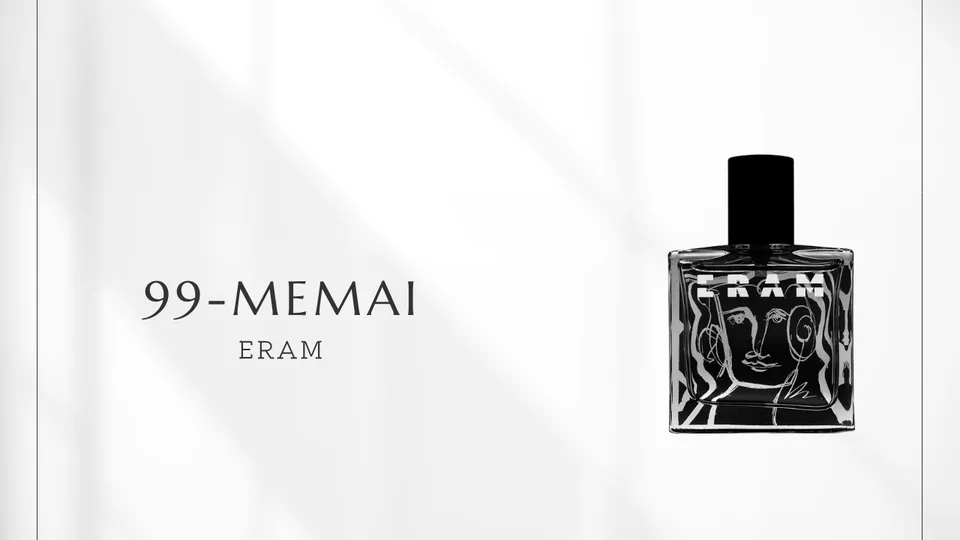
The packaging reportedly features abstract monochrome drawings by heso. The print-like images have deliberately blurred outlines so that each viewer takes away a different impression. What Memai's box illustration depicts has not been disclosed.
It suits anyone who wants an everyday scent of clean tea and citrus rather than sweetness. If you are after a sweet, nostalgic scene, ERAM's 1830 is worth trying too.
Wearing Experience, Occasions and Reputation
Memai is at its best in spring and summer, when its clean tea-and-citrus opening matches lighter clothing. It is also easy to wear on warm early-autumn days, while in deep winter under heavy layers its lightness tends to fade into the background. Daytime is ideal, when the bright citrus and tea come alive.
It is primarily an everyday scent. Retailers present it for both men and women, and it can be worn by anyone. With its restrained sweetness, it also fits the office and daytime outings. Linen or cotton shirts and light cotton tops for spring and summer are natural companions.
As an eau de parfum, it belongs to the more concentrated, longer-lasting category of fragrances. Few wearers have yet shared impressions of its longevity or projection, so if you are curious, a 2 ml kit vial will show how it lasts on your own skin.
Memai's poem says that feelings “from across the sea” become “a part of me” before the speaker realizes it. In a few lines, it traces a feeling that was once distant becoming something held within.