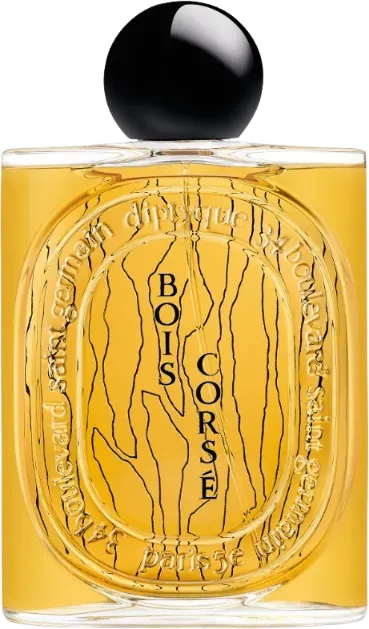
Bois Corsé
Bois Corsé is a woody eau de parfum that uses bitter Arabica coffee, creamy sandalwood, and warm tonka bean to portray the two sides of bark. A light application in cool weather reveals how differently coffee and sweetness balance on each wearer.
#442 · 2026-08-04
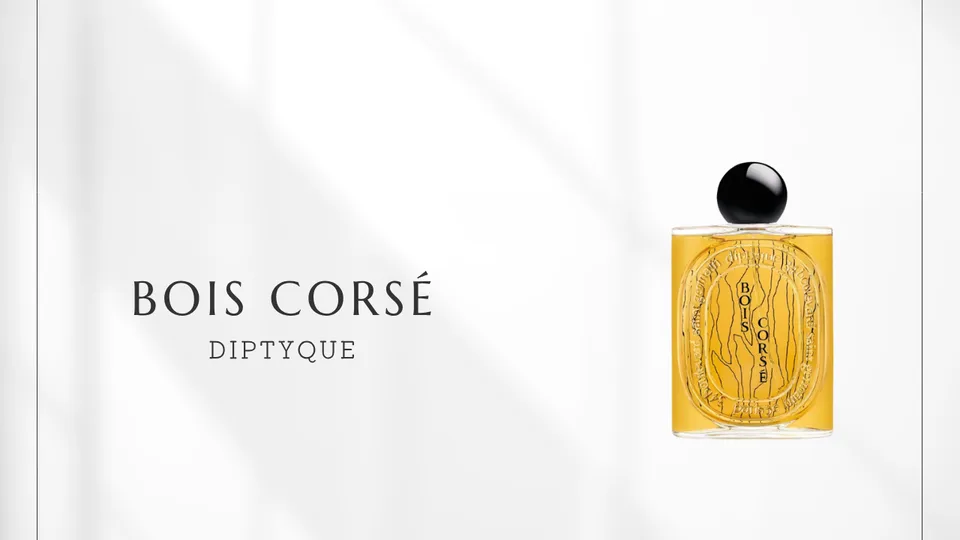
Basic Information and First Impression
Bois Corsé by Diptyque is a 2024 eau de parfum introduced as one of the first five fragrances in Les Essences de Diptyque. The current standalone bottle contains 100 mL. Its official key notes are Arabica coffee, sandalwood, and tonka bean. The result is woody without becoming simply dry, and gourmand without turning into a sweet café scent. Roasted bitterness and milky wood remain visible at the same time.
The name contains the idea in miniature. Bois means wood, while corsé can mean full-bodied or strong. It also echoes écorce, the French word for bark. Coffee vocabulary and the surface of a tree are therefore joined before the fragrance is even smelled. The coffee does not try to reproduce a drink; it gives the bark its dark color, roasted shadow, and rough texture.
Perfumer, Brand Background, and Creation Story
The co-perfumers are Nathalie Cetto and Olivier Pescheux. Pescheux was born in Paris in 1966, trained at ISIPCA, and worked with houses including Givaudan. His Diptyque creations include Eau des Sens, Fleur de Peau, and Orphéon. He died on July 10, 2023, at the age of 57, and Bois Corsé was released the following year. The precise division of work between the two perfumers has not been disclosed.
The project began with the irregular relief of bark. Bark protects the vulnerable center of a tree and grows rougher with time, yet its surface can still feel pleasing under the fingers. The composition translates that contrast into scent. Diptyque itself began in 1961 with Desmond Knox-Leet, Christiane Gautrot, and Yves Coueslant at 34 boulevard Saint-Germain in Paris. Les Essences de Diptyque extends the founders' interest in art and material objects by interpreting natural forms that do not have an obvious smell.
The bottle continues that approach. Its engraved oval acts like a lens, enlarging the name and the illustration placed on the back. Fine black lines evoke bark relief, while Nigel Peake's watercolor appears on the paper packaging. Sight, touch, and scent belong to the same object.
Detailed Scent Analysis
The official structure is not a top-heart-base pyramid. Arabica coffee, sandalwood, and tonka bean are presented as three parallel key notes. The stages below describe commonly reported wear rather than assigning the materials to an invented formal pyramid.
For roughly the first twenty minutes, deep-roasted coffee, ground beans, unsweetened cocoa, and charred wood can dominate. Arabica coffee absolute supplies the rough outer shadow. Some wearers, however, perceive vanilla or almond-like sweetness immediately, so the divergence begins in the opening itself.
From around twenty minutes to ninety minutes, the bitterness often recedes and sandalwood becomes creamier. Tonka bean adds warmth associated with vanilla, almond, hay, and soft powder. It is less a sugary latte than dark coffee softened by a small amount of milk and turned toward a woody cream.
After about ninety minutes, sandalwood, tonka bean, and dry woods settle closer to the skin. Coffee remains as a dark contour rather than disappearing completely. Other wearers find that all three key notes continue with little change. Bois Corsé is therefore a fragrance whose degree of development should be tested on skin.
Comparison and Positioning
Akro Awake shares the smell of freshly ground coffee. Awake keeps the drink bright with lemon, green cardamom, and vetiver. Bois Corsé dissolves coffee into pale sandalwood and moves away from the cup toward the texture of bark. Choose Awake for a more literal coffee direction and Bois Corsé for a quieter woody shadow.
BDK Parfums Gris Charnel shares creamy sandalwood and tonka warmth. Gris Charnel uses fig, black tea, cardamom, and iris to create a translucent, fabric-like grayness. Bois Corsé retains roasted coffee and the grain of bark. Spiced tea transparency and bitter wooden texture are the clearest points of difference.
Maison Margiela Replica By the Fireplace also combines roast, wood, and warmth. It moves toward smoke, burnt timber, and chestnut sweetness. Bois Corsé remains closer to milky sandalwood and subdued coffee. The temperatures are similar, but one projects a fireplace scene while the other stays close to the body like a tactile surface.
Buying Guide, Price, and Recommendation
The currently verified standalone format is Bois Corsé Eau de Parfum 100 mL. The Japanese official price observed on August 3, 2026 was ¥51,150. A 10 mL bottle appeared in the original five-fragrance discovery set, but it has not been verified as a regular standalone item. No EDT, Parfum, or Extrait concentration variant has been confirmed. Price, stock, and regional services should be checked on the current official site before purchase.
This is worth testing on skin rather than deciding from a blotter. A coffee-forward opening can become sweeter and milkier after several hours. On other skin, sweetness appears immediately and coffee fades quickly. It may disappoint anyone expecting either a literal espresso or an overtly sugary latte. It is more convincing for someone who values dry wood, restrained bitterness, and close-range texture over projection.
Wearing Experience, Scenes, and Reputation
Bois Corsé is most at home in autumn, winter, and cool evenings. It suits dinner, a hotel lounge, a museum, a bookstore, or a quiet café, and it pairs naturally with wool, coats, and jackets in black, brown, or ecru. Cool spring mornings and evenings can also work with a light application. In humid summer heat, the tonka and woods may feel heavy, so an air-conditioned room or a cool night is a safer setting.
Projection is commonly described as moderate at first, then within about an arm's length after one or two hours. Skin longevity often falls around four to eight hours, though reports range from fading at four hours to lingering until the next morning. Fabric can hold the darker coffee and cocoa impression for longer.
Positive reactions focus on milky sandalwood, coffee used as a subtle accent, and the balance between bitterness and sweetness. Critical reactions describe coffee candy, sharp bark, a composition that feels simple for the price, or coffee that disappears too soon. The disagreement is not incidental: it shows how strongly skin changes the coffee-to-sweetness ratio. Start with one spray in a close, non-sensitive setting and follow the drydown before deciding.