Karo-Karoundé
Rare West African white-floral material from *Leptactina senegambica*, prized for its narcotic, spicy-green, fruity-waxy floral depth in luxury compositions.
Aromatic
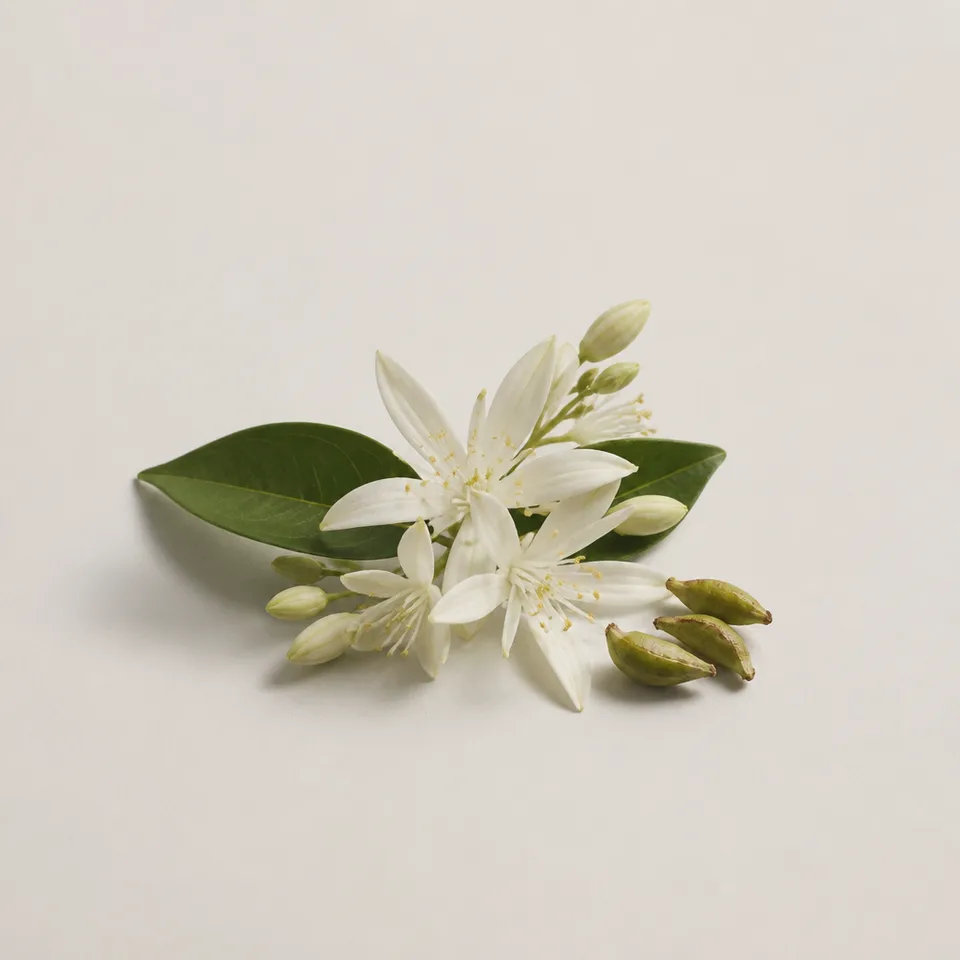
Karo-Karoundé
**Karo-Karoundé** is a **natural floral material** obtained from the flowers of *Leptactina senegambica*, a small shrub of the Rubiaceae family native to West Africa, especially Guinea and neighboring regions. The fragrant white, star-shaped blossoms are harvested and solvent-extracted to produce a concrete, then further processed into absolute or alcoholate for fine perfumery. Due to the plant’s limited habitat and very low yield (thousands of flowers for a gram of absolute), karo-karoundé is considered one of the rarest and most prestigious floral ingredients in perfumery. In addition to true absolutes, some suppliers offer all‑natural **reconstituted accords** that reproduce karo-karoundé’s profile at lower cost.
Scent profile
Karo-Karoundé presents an **intense, narcotic white-floral** aroma, often compared to jasmine, gardenia, tuberose, and ylang-ylang, yet clearly distinct from each. Its profile combines warm, waxy floral facets with **green, woody, and spicy** nuances, plus fruity and gourmand tones reminiscent of ripe tropical fruits, peach, plum, cacao, or chocolate-orange. Depending on quality and ripeness, it can smell from magnolia-like with animalic musk undertones to a richer, oriental floral with nutty and honeyed warmth. Overall it is perceived as voluptuous, sensual, and slightly wild, with great diffusion and persistence even in small amounts.
Use in perfumery
In perfumery, karo-karoundé is used almost exclusively in **high-end compositions** because of its cost and rarity. Classic references (e.g., Arctander) and contemporary natural-perfumery suppliers emphasize its role in **white-floral, oriental-floral, and chypre** accords, where it enriches gardenia, hyacinth, stephanotis, tuberose, and other opulent florals. It is valued as both a character note and a modifier: a trace can soften or brighten heavy bouquets, introduce spicy-green lift, or add depth in woody and incense contexts. Natural absolutes, concretes, alcoholates, and all‑natural bases are available, but production remains tiny and largely tied to West African harvests, so perfumers often reserve karo-karoundé for niche or artisanal work where its distinctive, exotic floral signature can be fully appreciated.