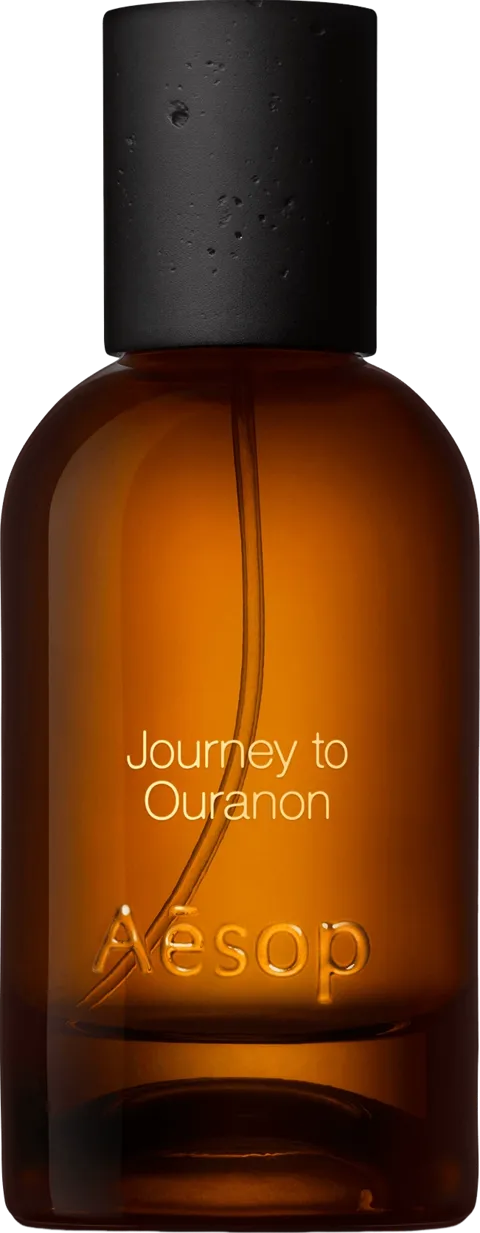
Journey to Ouranon
Aesop’s Journey to Ouranon moves from bright petitgrain through hay and chamomile to warm resins and earthy depth. Myrrh, patchouli and frankincense evoke mineral ash in a fable that turns spent embers toward a new beginning.
#518 · 2026-10-19
Fragrance Overview and First Impression
Aesop’s Journey to Ouranon is an eau de parfum built around woody, spicy and resinous impressions. It begins with a brightness reminiscent of citrus, moves through dried grass and soft herbs, and settles into warm resin and mineral earth. Its fable starts with embers turning to ash and smoke rising toward a new beginning. The movement from a light opening to a deeper finish makes the scent more varied than its imagery of ash might first suggest.
Journey to Ouranon belongs to Fragrant Fables, a collection that links scent and storytelling. Aesop describes the mineral quality of ash through myrrh, patchouli and frankincense. Those three notes occupy different levels of the official pyramid, yet they work together in the fragrance’s central image. The early herbal brightness gives the later resin more contrast.
The US site lists the renamed fragrance and new bottle under product code FR36. As of October 2026, Aesop’s Japanese site still lists Ouranon Eau de Parfum as FR28 in the earlier bottle. Both pages show the same nine pyramid notes. Neither establishes whether the formula changed or when the newer presentation will become available in Japan.
Perfumer, Brand and Creative Background
Barnabé Fillion has spoken about making the earlier Ouranon. He says photographing plants while studying photography helped begin his interest in perfume. For Ouranon, he researched frankincense and looked for materials that evoked rocks and stones, then imagined desert and nearly volcanic terrain. His account connects the resinous smell with the fragrance’s mineral setting.
Fillion also explained that the powerful stone image had become too still. Lavender flower and petitgrain brought softness, sparkle and movement. That botanical opening changes how the later resins are perceived. His comments describe the earlier Ouranon and do not establish whether any new perfuming work accompanied the later name and bottle.
The name Aesop refers to the ancient Greek fabulist. Fragrant Fables draws on the house’s respect for literature, giving each scent a story-like setting. Journey to Ouranon presents embers becoming ash, smoke moving into the sky, and a landscape opening to renewal. The earlier Ouranon had been discussed in terms of an ending; the newer official fable emphasizes a new beginning. Each description belongs to its own published context.
Scent Analysis
The official structure has top, middle and base notes. Petitgrain gives the top a citrus-like lift with a leafy edge. Elemi carries a light resinous brightness, while lavender flower adds a soft herbal-floral quality. Together they create an open beginning before the warmer materials become prominent.
In the middle, hay suggests dried grass and chamomile brings a gentle floral-herbal softness. Frankincense adds a clearer incense quality. This stage leads from bright greenery toward resin and smoke. Ash is the image Aesop builds from the composition, rather than the name of another official pyramid note.
Myrrh gives the base a warm resinous depth. Tonka softens its edges, while patchouli adds an earthy weight. Aesop identifies frankincense, myrrh and patchouli together as the materials that evoke mineral ash, even though frankincense is listed in the middle and the other two in the base. Labdanum resinoid appears in the fragrance’s descriptive material as a source of lingering warmth; it is not an extra level of the listed pyramid.
Comparisons and Positioning
Heeley’s Cardinal is a useful comparison for its resinous incense. Both fragrances feature frankincense and myrrh. Journey to Ouranon adds patchouli to its image of mineral ash and warm earth. Cardinal pairs its incense materials with white linen, black pepper and vetiver, moving toward a cleaner fabric impression. The choice is between a grounded, earthy resin and a fresher kind of incense.
Maison Margiela’s By the Fireplace offers another way to depict fire and smoke. Journey to Ouranon focuses on the ash after the fire and follows it toward renewal. By the Fireplace uses clove, guaiac wood and cade oil to evoke burning logs, with chestnut contributing to its hearth setting. Both have a smoky story, but one settles into resin and mineral earth while the other keeps the scene of a burning fireplace close.
Zoologist’s Harvest Mouse offers a comparison through hay and chamomile, which give both fragrances a grassy heart. Journey to Ouranon moves from those herbs toward resin and mineral ash. Harvest Mouse pairs them with davana and beer extract to evoke a grain field at harvest. The choice is between a grassy opening that settles into incense and earth, and a fragrance centered on the warmth of a harvest field.
Buying Guide and Suitability
Check the product name and code before buying. The US Journey to Ouranon is FR36, listed as a 50 mL eau de parfum. Its new amber-glass bottle has an embossed Aesop insignia. The textured cap takes its inspiration from basalt associated with Melbourne, the brand’s home city. This bottle design belongs to the Fragrant Fables presentation rather than being a shape unique to this one scent.
As of October 2026, Aesop’s Japanese site lists the earlier Ouranon Eau de Parfum as FR28 in the earlier bottle. The listed 50 mL price there is ¥23,870 including tax. The two product pages give corresponding sets of nine pyramid notes, but they do not state whether the formula changed. The timing of any Japanese switch to the newer name and bottle is also unconfirmed. Current prices and availability are best checked on the relevant official store page.
On skin, allow the fragrance to move beyond its bright opening before deciding. The hay and chamomile heart leads into a warmer resinous finish, and some wearers of the earlier Ouranon describe the initial impression becoming calmer over time. Someone seeking both herbal lightness and warm resin may enjoy that change. Someone who wants the opening to remain light throughout should pay particular attention to the drydown.
Wearing Experience and Reception
Accounts from wearers of the earlier Ouranon make autumn and winter the most promising seasons. Its warm resin can suit a cool-weather outing with knitwear or a wool layer. Some people also imagine it in a quiet indoor setting, at a museum, or before bed. Spring has its supporters, while hot summer afternoons can make the scent feel heavy to some wearers. These are observations about the earlier named product, not a separate wear study of FR36.
Users describe its projection as gentle to moderate. Skin wear varies, and Aesop does not give a numerical lasting-time claim for the newer product. Testing it over several hours on your own skin is the clearest way to judge how the change from herbs to resin works for you. The brand suggests applying it to the wrists and neck.
Comments on the earlier Ouranon mention soft lavender and chamomile, as well as an impression reminiscent of earth after rain. Others find the opening stronger before it settles. The appeal lies in that progression: bright botanicals make room for resinous warmth and an earthy finish.