Dancing on the Moon
Cold aldehydic light, milky iris powder, jasmine, and frangipani compose an imaginary Moon Dust. The episode follows Fanny Bal's creative background, three comparisons, the black-and-silver bottle, and a skin-first guide to wearing it, especially in spring and summer.
#453 · 2026-08-15
Basic Information and First Impression
Maison Margiela REPLICA Dancing on the Moon is a floral-powdery eau de parfum built around lunar dust and a dance in weightlessness. First released in 2016 as one of four imagined worlds, it returned to the foreground in 2024 within the black-bottled FANTASIES collection.
Its first impression is silver, milky white, and black. Aldehydes and moonflower create a clear, cold shimmer. Behind that light come the powder of iris and the white petals of jasmine and frangipani. These flowers are radiant without turning toward tropical sunlight. Keeping the bouquet cool is the fragrance's defining tension.
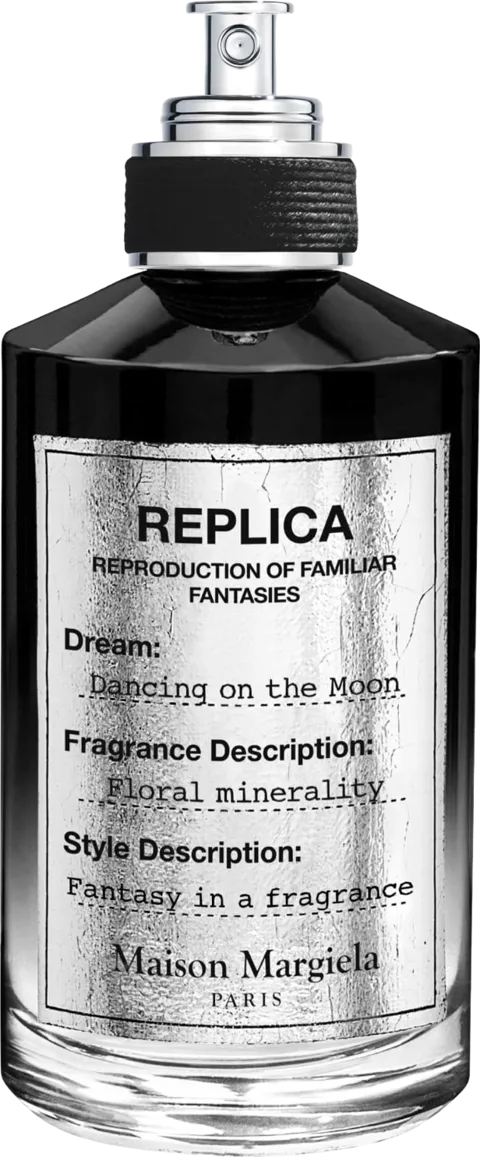
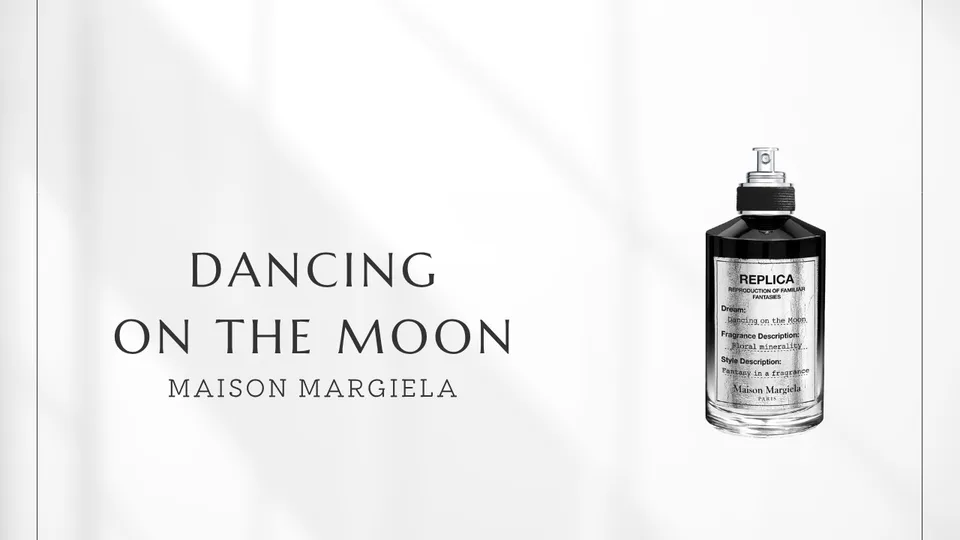
The heavy glass bottle is coated in a black gradient, tied with black rope, and finished with a textured silver label. The familiar transparent REPLICA bottle preserves memory; this darker vessel signals night and fantasy. The current format is 100 ml.
Perfumer, Brand Background, and Creation Story
Fanny Bal is the perfumer, credited directly by Maison Margiela as Master Perfumer for this composition. Trained at ISIPCA and mentored by Dominique Ropion, she was not trying to reproduce the literal smell of lunar soil. Her challenge was to use real perfumery materials to invent something that cannot be smelled in reality.
That imaginary material is Moon Dust. The cold metallic flash of aldehydes, the milky powder of iris, and the lift of jasmine and frangipani are bound together until they read as a single substance. Real ingredients become an impossible material, expressing the central idea of FANTASIES.
REPLICA Memories locates shared recollections in a place and time. FANTASIES moves toward flight, a forest with a soul, and dancing on the moon. Maison Margiela presents the two collections as complementary, like day followed by night.
In the 2024 campaign The Fantasy Experiment, dancer Francesca Hayward embodied Dancing on the Moon. Her movement returned the fragrance's pulse and weightlessness to the body, turning the verb in the title into choreography.
Detailed Scent Analysis
The official construction is a three-stage pyramid of top, middle, and base notes.
The top combines aldehydes and moonflower. Aldehydes give the silver Moon Dust a cold metallic glitter. On skin, the opening may suggest transparent air, white soap, ozone, or sunscreen. These are not listed ingredients but different readings of the same cool, clean brightness.
The middle contains iris accord, jasmine sambac, and frangipani tree. Iris brings both floral radiance and milky powder. Jasmine and frangipani supply a vivid white bouquet, while the continued aldehydic chill prevents it from becoming a warm tropical floral. Ylang-ylang also supports the separately described white-flower bouquet with a slight rise in temperature.
The base is cashmeran, ambergris accord, and musk. Dry wood and soft skin textures hold a thin trace of the metallic light. Some wearers find the late powder restrained and silky, wrapped in gentle musk. The silver chill does not vanish entirely; it settles at a small distance from the skin.
The most distinctive moment is the coexistence of inorganic aldehydic light and living white flowers. It feels cold without weakening the bouquet, and floral without warming into sunlight. That imbalance gives the imaginary lunar setting its conviction.
Comparison and Positioning
Le Labo Lys 41 shares jasmine-led white florals, musk, and a clear presence. Lys 41 layers jasmine, tuberose absolute, and lily over wood, vanilla, and musk, producing a warm, solar bouquet. Choose Lys 41 for floral volume and heat; choose Dancing on the Moon for white petals cut by cold air and metallic light.
Diptyque Fleur de Peau Eau de Parfum also uses iris, musk, and a tactile powdery surface. Fleur de Peau builds an intimate skin story from musk, iris, ambrette, and pink pepper. Dancing on the Moon points away from skin toward a cold lunar landscape. The distinction is between downy, bodily powder and milky lunar dust.
Frédéric Malle Iris Poudre shares the glitter of aldehydes, iris powder, and white musk. Rose, violet, and tonka give Iris Poudre a creamy bridge to twentieth-century aldehydic florals. Dancing on the Moon moves toward a futuristic cool palette through jasmine, frangipani, and Moon Dust. One offers classical cosmetic elegance; the other an abstract lunar whiteness.
Buying Guide, Price, and Recommendation
The currently confirmed fragrance version is REPLICA Dancing on the Moon Eau de Parfum in 100 ml. The Japanese official price was ¥33,550. Price, inventory, and availability can change, so the current official listing should be checked before purchase.
The fragrance first appeared in 2016. After a period when it became difficult to obtain, Dancing on the Moon, Flying, and Soul of the Forest returned to prominence in 2024 as FANTASIES. Whether the present formula is completely identical to the 2016 version cannot be determined from availability or bottle design alone.
This suits someone who enjoys jasmine and frangipani but wants cool air, powder, and a metallic glint rather than warm sweetness. It can also appeal to a wearer looking for an unusually clean white floral. Jasmine can become forceful, however, and the metallic facet may suggest rubber on some skin. Test beyond the opening and wait through the white-floral middle into the musky finish.
Wearing Experience, Scenes, and Reception
The fragrance is presented for year-round wear, with particular emphasis on spring and summer. Spring light brings out aldehydic transparency, while a summer night suits the contrast between white flowers and the black lunar story. In autumn or winter, it works best when cool powder is more desirable than warm sweetness.
Museums, exhibition spaces, quiet offices, and dinner at night fit its controlled brightness. White shirts, black jackets, matte gray fabrics, and silver jewelry extend the palette of silver, milky white, and black into clothing.
Longevity and projection vary widely. Some wearers feel it softens after roughly four hours, while others experience a long, strong trail. Jasmine may bloom richly on one person and the metallic edge may sharpen on another. Begin with a modest application in close settings, avoid adding more too quickly, and wait for the musk to settle near the skin.
Positive responses focus on the clean but fantastical white flowers, aldehydic sparkle, iris powder, and black-and-silver world. Less favorable readings mention ozone, sunscreen, strong jasmine, or a rubber-like metallic edge. These impressions reveal the composition's central tension between inorganic light and living petals. The final decision belongs on skin: whether the wearer wants uninterrupted softness or enjoys the strain between a flower and a cold beam of light.