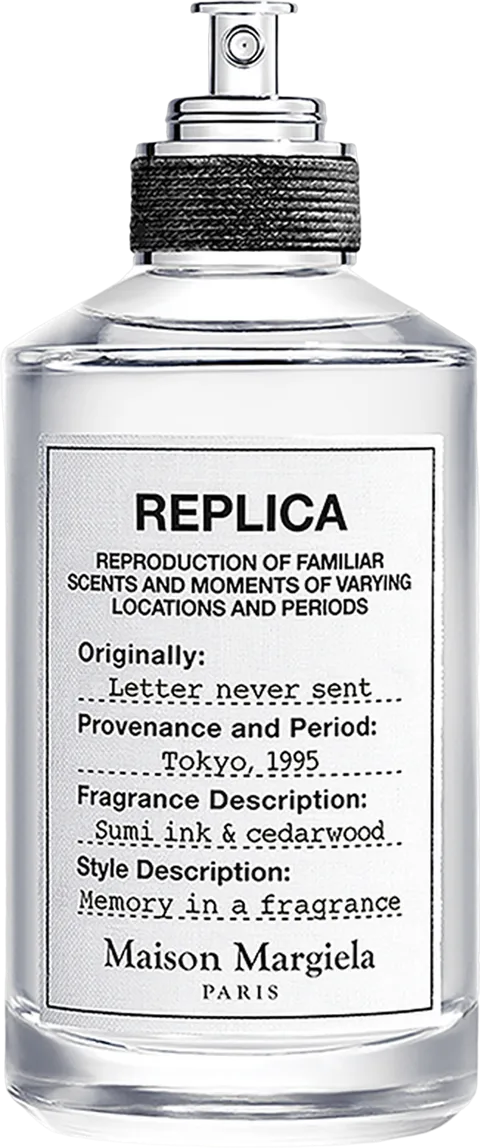
Letter Never Sent
Letter Never Sent is a woody musk built around an unsent letter in Tokyo, 1995. Its official key notes pair a dry, mineral Sumi Ink Accord with warm Red Cedarwood and smooth White Musk. Released on October 1, 2026, it is sold at selected Tokyo stores.
#516 · 2026-10-17
Fragrance Overview and First Impression
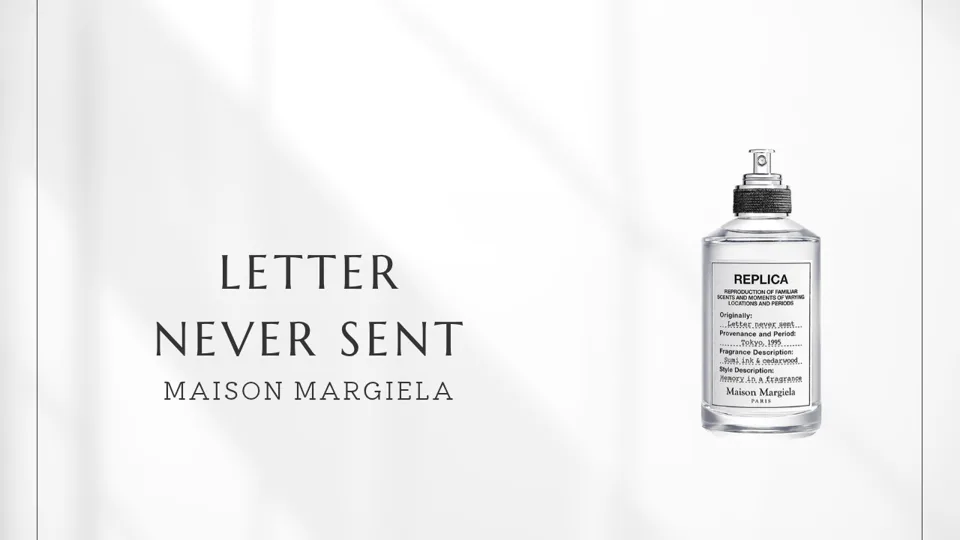
Maison Margiela's Letter Never Sent is an eau de parfum released on October 1, 2026. Its Japanese retail name includes Replica Eau de Parfum, and it is the brand's first fragrance limited to selected Tokyo stores. The official fragrance family is woody musk. Its setting is Tokyo in 1995, where a letter has been written but kept rather than sent. In Japan, it was announced and sold under the name Tokyo Memories; its sales name, the one printed on the bottle’s label, is Replica Eau de Parfum Letter Never Sent.
Three official key notes give the scent its shape: Sumi Ink Accord, Red Cedarwood, and White Musk. The ink suggests a mineral dryness, the wood brings warmth, and the musk smooths the overall impression. The slight metallic edge described for the ink is linked to the brightness of the city, while wood and musk make room for the private moment of writing.
The Japanese product listing shows one 100 mL size at ¥31,900 including tax. Its limited distribution makes an in-store test especially useful: the story may be compelling, but the deciding detail is whether the dry ink texture feels right on skin.
Perfumer, Brand, and Creative Background
Maison Margiela's Replica Memory Collection takes inspiration from the Replica capsule collection in fashion, built around the idea of timeless universality. The bottle shares the series' common shape: clear glass with a white label resembling a tag sewn inside a garment. The fragrance line uses a particular scene to evoke memory and mood. Replica Jazz Club, for example, depicts a Brooklyn jazz club in 2013, with cocktails and cigars, while Lazy Sunday Morning portrays a sunny Sunday morning in Florence in 2003, with freshly washed linen against the skin. Letter Never Sent turns to Tokyo in 1995, with an unsent letter at the center of its story. The setting gives a concrete reason for the composition's focus on ink and the surface of paper.
The official narrative places a lasting handwritten letter beside a draft that can be erased from a screen. The movement of a pen across paper and the trace of ink left behind make the unsaid words tangible. It also brings the ink of 1995 into conversation with the noise of Tokyo in 2026. That contrast allows the fragrance to suggest a private thought within a busy city.
Before the launch, two letters appeared in Shibuya as part of the brand's campaign. Visitors could write thoughts they had not voiced in the blank space. At the concept store in GINZA SIX, a shopping complex in Ginza, the planned LETTER BAR offered a place to write, while a PHOTO BOOTH drew on Tokyo in 1995 and the fragrance's setting. These experiences extend the idea of ink and paper beyond the bottle.
The available official material does not identify an individual perfumer for this fragrance. The three stated notes and the Tokyo letter setting provide the reliable way to understand its creative direction.
Scent Analysis
The official product page lists Sumi Ink Accord, Red Cedarwood, and White Musk. It does not assign them to opening, heart, and base stages. Reading the notes as complementary textures is more useful here than predicting a sequence the brand has not specified. Their relationship moves between the harder dryness of ink and the softer warmth of wood and musk.
Sumi Ink Accord evokes ink drying on paper. Its mineral clarity has a dry edge, and the brand describes a faint metallic quality. That detail links the glitter of the city with the quieter act of facing a letter alone. The accord offers a distinct entry point for someone interested in an ink scent without needing to promise a literal smell of every kind of writing ink.
Red Cedarwood brings warmth to that drier impression. The official description refers to cedarwood from Virginia and associates its rich woody texture with the comfort of a quiet night. Ink and wood both lean dry, but the difference in temperature gives the pairing depth. The cedarwood makes the mineral edge feel less severe while keeping the composition grounded.
White Musk provides the clean, smooth feel. The brand connects it with skin touching fine paper and with a gentle finish. Alongside the mineral ink and warm cedarwood, it suggests not only the act of writing but also the closeness of keeping the finished letter. Its softness does not erase the drier materials; it makes their contrast easier to feel.
At a store, pay attention to how the ink's slight metallic aspect reads to you and whether the wood and musk give it a comfortable balance. The official listing gives approximately five to six hours as a wear-time guide. Actual wear can differ from person to person.
Comparisons and Positioning
Comme des Garçons Parfums' CDG 2 offers the clearest comparison through shared note names. Both official lists include ink and cedarwood. CDG 2 also lists incense, amber, and patchouli, and its concept emphasizes reflections, opacity, light, and shadow. Letter Never Sent pairs its Sumi Ink Accord with Red Cedarwood and White Musk in a story about Tokyo and an unsent letter. The two works give different contexts and supporting materials to their shared ink and wood vocabulary.
Diptyque's L'Eau Papier shares the idea of paper and ink. It is a fragrance about paper, and the brand describes it as the creative moment when hand, ink, and blank page become one. White Musk is the official note they share. L'Eau Papier combines it with rice steam accord, mimosa, and blond woods accord. In Letter Never Sent, musk smooths the dry ink and cedarwood. The choice depends on whether the mineral character of ink appeals more than the rice and floral elements surrounding musk in L'Eau Papier.
Perfumer H's Ink pairs ink and paper in a different way. The brand describes it as the scent of blue ink placed on white paper, set late at night in a dimly lit library. It combines Indian papyrus, Haitian vetiver, and cedarwood with elemi resin from Iran and rose, finished with a touch of Ambroxan and isobutyl quinoline. Letter Never Sent instead wraps a Sumi Ink Accord drying on paper in the warmth of Red Cedarwood and the clean smoothness of White Musk. Choose Letter Never Sent for ink in the spirit of sumi; Perfumer H's Ink suits someone drawn to a night scene of paper and blue ink.
Across these comparisons, the distinctive feature is how Letter Never Sent joins its materials to Tokyo in 1995 and an unmailed letter. Shared note names are a useful starting point, but the supporting notes and the scene each fragrance asks the wearer to imagine matter just as much.
Buying Guide
Letter Never Sent is sold at selected stores in Tokyo and is unavailable from the official online store. The Japanese product page lists 100 mL at ¥31,900 including tax. Stock and prices can change, so the official store information is the best place to check before visiting. The Tokyo limitation is a practical consideration for anyone who cannot easily return for another test.
It may suit someone interested in the feel of handwritten letters and in a dry pairing of ink and wood. If bright sweetness or a prominent floral note is your usual starting point, try the mineral ink accord on skin before deciding. A connection with the story can deepen the appeal, but the texture of the scent is what you will live with.
When testing it, notice the dry and faintly metallic side of the ink first, then consider the warmth of the wood and the smoothness of the musk. The brand does not assign the notes a timed order, so there is no need to expect a particular material to appear at a specified minute. Give your own impression enough time to develop before choosing a 100 mL bottle.
Wearing Experience and Impressions
The official material does not designate a season or dress code for Letter Never Sent. Its story suggests a quiet moment with paper and wood, perhaps a time set aside for one's own thoughts. That is an interpretation of the concept, not a measured claim about how it projects in a room. The useful question is whether its dry ink character feels comfortable in the setting where you would wear it.
Some wearer impressions describe the ink as mineral or inanimate; another likens the scent to a clean envelope kept for years. Responses to the woody side vary. These impressions help explain why an in-person test matters, especially for an accord that can feel familiar as an idea yet unusual on skin. The pleasure of a paper association does not settle whether the actual dryness will appeal to everyone.
The official wear-time guide is approximately five to six hours, although persistence and spread will vary. At a Tokyo stockist, consider both the first impression and the way the wood and musk sit beside the ink for you. The lasting reason to choose it is the particular balance of mineral dryness, cedarwood warmth, and clean softness, together with the letter it brings to mind.