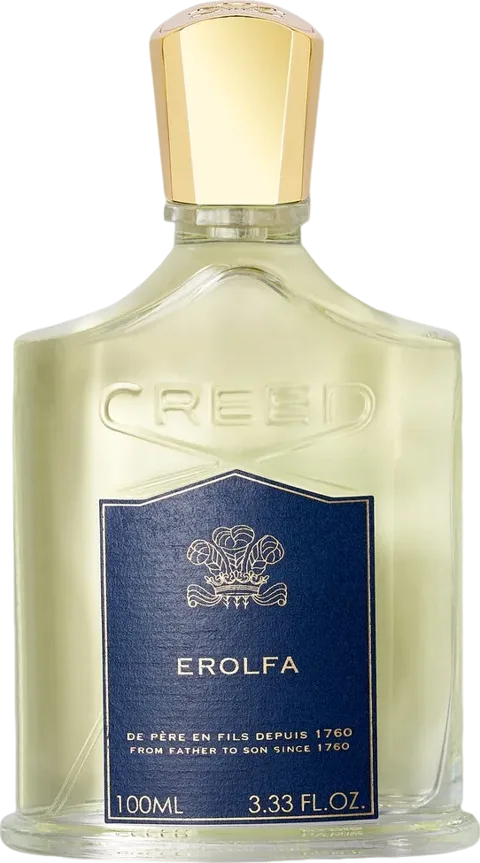
Erolfa
Creed's Erolfa takes its name from a yacht linked to the family's Mediterranean travels. Citrus, basil, and ginger lead into watery florals and herbs before settling into woods and musk.
#513 · 2026-10-14
Fragrance Overview and First Impression
Creed's Erolfa begins with bright citrus shaped by basil and ginger. Lemon and mandarin suggest immediate freshness, while the herbs and spice give the opening a sharper edge. Lavender, watermelon, and cucumber then move the fragrance toward a cooler, more watery impression. Woods and musk bring the later stage to a gentler close. The change between these stages is more informative than the first burst alone.
Creed classifies Erolfa as aromatic fougère, marine, and floral. Its story evokes a Mediterranean yacht deck in strong summer sun, with sea air passing through. The official notes show how that scene is expressed: citrus and herbs at the start, watery fruit and flowers in the heart, and wood at the base. The marine setting is an inspiration, while those materials give the fragrance its particular shape.
The current US product listing calls Erolfa an Eau de Parfum, and the Japanese listing shows 50 mL and 100 mL options. Waiting for the heart to develop on skin reveals more than testing only the opening.
Perfumer, House, and Inspiration
Creed does not officially credit a perfumer for Erolfa. Some sources name Olivier Creed, while others attribute it to Pierre Bourdon. Creed describes Olivier Creed's family's Mediterranean travels as the inspiration, without establishing how either perfumer contributed to the composition.
Erolfa was also the name of a yacht owned by the Creed family. Its name combines ER from Erwin, OL from Olivia, and FA from Fabienne. Those details make the boat a specific part of the family story rather than a general image of the sea. The naming does not establish that the three people participated in making the fragrance.
Creed describes its house through British tailoring and French know-how. For this fragrance, the family voyage gives context to a progression of citrus, aromatic herbs, watery fruit, flowers, and wood. Knowing the story adds a setting; following the materials explains what distinguishes the scent itself.
Scent Analysis
Erolfa is presented in three tiers: top, heart, and base. The opening lists lemon, lime, mandarin, bergamot, basil, and ginger. Several citruses build the brightness, while the green herbal feel of basil and the bite of ginger give it a clear outline.
Lemon and lime suggest a clean tartness, and mandarin adds a slightly softer fruit impression. With bergamot joining them, no single citrus takes the lead. Basil and ginger layered together give the freshness a light tension.
The heart lists violet accord, fresh florals, lavender, coriander, watermelon, cucumber, and Indian jasmine. Lavender and coriander carry the herbal impression, while watermelon and cucumber add a watery feel. Even after the citrus energy settles, the coolness continues in a new form.
Here, watermelon and cucumber are better read as cues for juiciness than as fruity sweetness. That wateriness overlaps the herbal freshness of lavender and coriander, and the floral side, including violet accord and Indian jasmine, keeps the scent from turning monotonous.
The base list names sandalwood, musk, and dry woods. The product description says sandalwood, cedarwood, and musk create the finish. Once the citrus and herbs calm down, wood and musk leave a quiet impression close to the skin.
A brisk top, a watery middle, and wood and musk at the end: this progression is what to listen for and what to check when testing. Judging by the first citrus alone, you can miss the herbal coolness built by lavender and cucumber, and the quieter side that follows.
Comparisons and Position
Creed's Millésime Impérial offers a comparison through citrus, woods, and a sea-associated setting. Erolfa makes herbs and watery fruit more explicit in its official note structure: basil, lavender, coriander, watermelon, and cucumber all contribute to its development. Someone looking for those shifts within a fresh fragrance has a reason to try Erolfa. Wearing both is the clearest way to judge their finer differences.
Giorgio Armani's Acqua di Giò Profondo Eau de Parfum also meets Erolfa around citrus, lavender, and a marine impression. Profondo lists rosemary, cypress, and patchouli among its characteristic notes. Erolfa's basil opening and its watermelon and cucumber heart give it a different combination of herbs and watery fruit. Comparing the heart of each fragrance, after the first bright moments have passed, makes the choice more useful.
Versace's Dylan Blue Pour Homme offers another comparison through bergamot, musk, and watery freshness. Its fig leaf, patchouli, black pepper, and saffron distinguish it from Erolfa, whose lavender, watermelon, and cucumber carry the scent from citrus toward herbal freshness. Someone drawn to that cooler, greener progression has a reason to try Erolfa.
Buying Guide
Creed's Japanese product page lists 50 mL and 100 mL sizes. It also displays a price of ¥39,050, but the saved page information does not establish which size that price belongs to. Check the selected size and its current price together before purchasing. The current US listing identifies the product as an Eau de Parfum. Claims about another concentration or earlier formula need separate product evidence.
Allow the fragrance to reach its heart during a skin test. The vivid lemon, mandarin, basil, and ginger opening gives way to lavender, watermelon, and cucumber before woods and musk become more apparent. Enjoying that full progression is a better basis for choosing a size than the opening alone. Creed also notes that packaging may vary during a transition, so a buyer who cares about presentation should check the current listing.
Wear, Seasons, and Impressions
Erolfa's official story depicts a boat deck in midsummer. Creed also describes the fragrance as suited to all seasons. Summer gives its citrus and watery herbs a natural setting; spring and autumn can suit daytime wear, while the woody and musky finish is worth testing on skin in winter. Temperature, clothing, and distance from other people help determine how it works in a particular setting.
A light shirt on a daytime outing is one possible match. In a close workplace, testing the opening and its later projection on skin can help determine the amount to wear. Some user accounts appreciate its gentle spread, while reports of longevity vary. The way the woods and musk remain after the citrus settles is more useful to observe than relying on one wear-time figure.
Creed also suggests layering Original Santal underneath Erolfa to draw out its spicy, woody facets. Testing Erolfa alone first makes the movement from citrus to herbs, wateriness, and wood easier to recognize. Its family yacht story becomes most memorable when connected to that specific progression of materials.