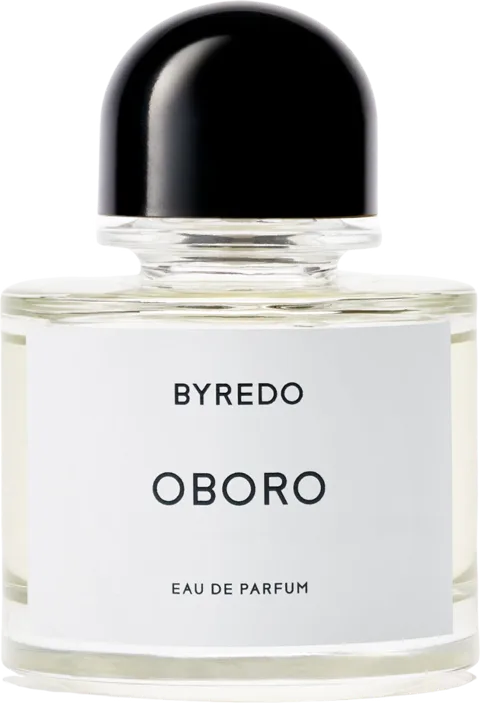
OBORO
This episode explores Byredo OBORO, a Japan-exclusive Eau de Parfum that moves from bergamot and dry spices through translucent flowers and minerals into incense, vetiver, and salted amber. It also covers the poetry, photography, film, and packaging behind its hazy concept, plus practical wearing guidance.
#433 · 2026-07-26
Basic Information and First Impression
OBORO by Byredo is a Japan-exclusive Eau de Parfum released on July 16, 2026. Its name comes from the Japanese word oboro, a state in which outlines become hazy. The idea extends beyond disappearance to memory softening over time and to the border between presence and absence, clarity and ambiguity.
The first impression is cool light. Bergamot is sharpened by black pepper and ginger, then the firm opening shifts toward flowers and damp stone. Incense, dry roots, and salted amber finally bring the scent closer to warm skin. Its identity lies in keeping cool air and human warmth at the same distance.
Perfumer, Brand Background, and Creation Story
Jérôme Epinette is credited as the perfumer. Raised in Burgundy, he studied biochemistry in Dijon, trained in perfumery in Grasse, joined Robertet in Paris in 2003, and helped open its New York creative center in 2006.
Epinette has spoken about his interest in woods and in creating atmosphere with a focused palette. OBORO similarly changes the space between a few contrasts: light, flowers and stone, smoke and skin warmth.
Byredo was founded by Ben Gorham in Stockholm in 2006. For OBORO, the house worked with poet and artist Gozo Yoshimasu, photographer Yuichiro Noda, and filmmaker Umi Ishihara. Handwritten language, flowers, intimate portraiture, and abstract film extend the idea of oboro across scent, image, and time.
Detailed Scent Analysis
The top notes are bergamot, black pepper, and ginger. Bergamot gives transparent yellow-green light, while the spices add dry heat and tension rather than sugary citrus.
The heart combines peony, violet, and a mineral accord. The flowers feel seen through mist rather than presented as a full bouquet. Mineral coolness suggests wet stone and rain-darkened pavement, keeping the floral core from becoming soft or sweet.
The base is incense, vetiver, and salted amber. Incense draws a quiet line of smoke, vetiver contributes dry root and wood, and salted amber leaves warmth close to the skin. The opening coldness does not vanish; its focus moves inward.
Comparison and Positioning
Le Labo Baie 19 emphasizes juniper, patchouli, wet earth, and the atmosphere after rain. OBORO shares the mineral humidity but adds peony, violet, and salted amber. Choose Baie 19 for wet soil and plants; choose OBORO for a transition from flowers and stone to skin.
Byredo Blanche uses aldehydes, peony, and violet to make white fabric and cleanliness explicit. OBORO adds pepper, ginger, minerals, incense, and salt. Blanche is the brighter laundry-white option; OBORO carries gray humidity and quiet smoke.
Byredo Gypsy Water also features bergamot, pepper, incense, and amber, but moves toward dry forest and campfire travel. OBORO uses flowers, stone, and salinity to suggest an urban atmosphere after rain.
Buying Guide, Price, and Recommendation
The official Japanese prices are ¥32,120 for 50 ml and ¥46,090 for 100 ml. These are two sizes of the same Eau de Parfum, not different concentrations or formulas. Because early opinions on performance vary, size should follow skin testing rather than price per milliliter alone.
Test the bergamot and spices on paper, then wait at least an hour on skin for the floral-mineral heart and the incense, vetiver, and salted amber drydown. OBORO suits people who prefer translucent flowers, damp stone, and quiet smoke over a sweet bouquet. It may disappoint those looking for a loud sweet evening fragrance or a clearly aquatic marine scent.
Wearing Experience, Scenes, and Reputation
The most natural season runs from the rainy period into early autumn. Try one spray in the morning or evening, or in an air-conditioned interior during midsummer. Galleries, bookstores, cafés, quiet meals, and city streets after rain give the fragrance enough space to reveal its changes.
White shirts, light-gray jackets, fine neutral knits, and fluid trousers suit its balance of softness and structure. A black shoe or accessory can echo the dry vetiver and incense in the base.
Early reactions describe OBORO as cool, transparent, urban, and increasingly soft over time. Other wearers report a short-lived opening, soapiness, an insect-repellent association, or insufficient value for the price. Performance reports also range from intimate wear of about six hours to above-average diffusion. The small sample means skin testing remains more useful than a single numerical claim.