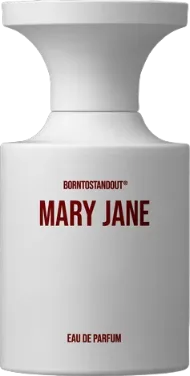
MARY JANE
BORNTOSTANDOUT's MARY JANE collides cannabis, frozen mint and tart fruit with caramel and pine. The composition moves abruptly from cold green sharpness to burnt sweetness, preserving the tension instead of smoothing it away.
#304 · 2026-03-19
A Perfume That Argues With Itself
MARY JANE is an eau de parfum from BORNTOSTANDOUT, the Seoul fragrance house whose identity is built around refusing to blend in. The brand classifies it as woody aromatic and green fruity, and its own framing is unusually direct: cannabis and pine-liqueur greenness, chilled with icy mint, then brought down onto caramel and pine.
The name does double work. "Mary Jane" can evoke the neat, strapped shoe associated with a well-behaved school uniform, and it has also long served as slang for cannabis. The perfume is built on that collision rather than on either half alone. Its official story imagines someone who would choose a wild bouquet of cannabis and a glass of pine liqueur over roses and champagne. The composition follows her lead: cold and sharp at the opening, unexpectedly sweet at the base.
What you should not expect is a seamless transition. The changes in texture are abrupt by design. That contrast is the central idea, not a flaw the fragrance is trying to hide.
Camille Chemardin and a Seoul Provocateur
The official product page credits Camille Chemardin as the perfumer. MARY JANE gives Chemardin a brief built from collision: cannabis and frozen mint form an aggressive green front, rhubarb throws acid at it, and caramel catches everything on the way down.
The brand around it matters just as much. BORNTOSTANDOUT was founded in Seoul by Jun Lim and presents perfume as a way of resisting conformity. Its opaque white bottles reinterpret Korean white porcelain, while crimson lettering breaks the calm surface. MARY JANE applies that same visual logic to scent: restraint on the outside, provocation in the name, and a formula that moves between green austerity and burnt sweetness.
Ice, Fruit, Then Burnt Sugar
The head combines hemp essence, cannabis, frozen mint, rhubarb and grapefruit. The mint arrives cold — closer to menthol crystals than the rounded coolness of a traditional aromatic cologne — while rhubarb brings a sour edge and grapefruit adds rind-like bitterness. The hemp and cannabis materials read dry and vegetal here, more crushed leaf than smoke.
The heart lets the temperature climb. Sage essence keeps an herbal thread going, passion fruit adds tropical acidity, and elemi essence supplies a lemon-tinged resinous bridge. Depending on skin, either the green materials or the tart fruit can take the lead, which is one reason sampling matters.
The base is where the concept lands. Caramel gives a burnt-sugar sweetness, pine essence keeps a cool coniferous bite cutting through it, and cashmere wood softens the edges. "Electric woods" is the abstract element in the list — a deliberately modern woody effect rather than a literal plant name. Sweet and sharp end up holding each other in place rather than resolving.
Where It Sits Among Cannabis Perfumes
Against Nasomatto's Black Afgano, MARY JANE is almost an inversion. Black Afgano is dark, resinous and nocturnal; MARY JANE is cold, green and lit from above.
Boy Smells' Italian Kush shares a hemp-and-citrus direction but stays brighter and more playful, while MARY JANE adds tart tropical fruit and a gourmand base. Byredo's Open Sky also pairs cannabis with citrus, then grounds the idea in dry woods. MARY JANE is less naturalistic than any of them: a conceptual treatment of the material built around mint, fruit and caramel.
What You Are Actually Buying
MARY JANE is currently sold in a 50ml eau de parfum. BORNTOSTANDOUT describes its eau de parfum line as containing 30–40% fragrance concentration, a house claim worth knowing when deciding how heavily to apply it.
That percentage should not be treated as a promise of a particular number of hours on skin. Concentration, diffusion and persistence are different things, and the unusually sharp mint can make the opening seem larger than the later woods. Begin with a small application and judge the full transition before adding more.
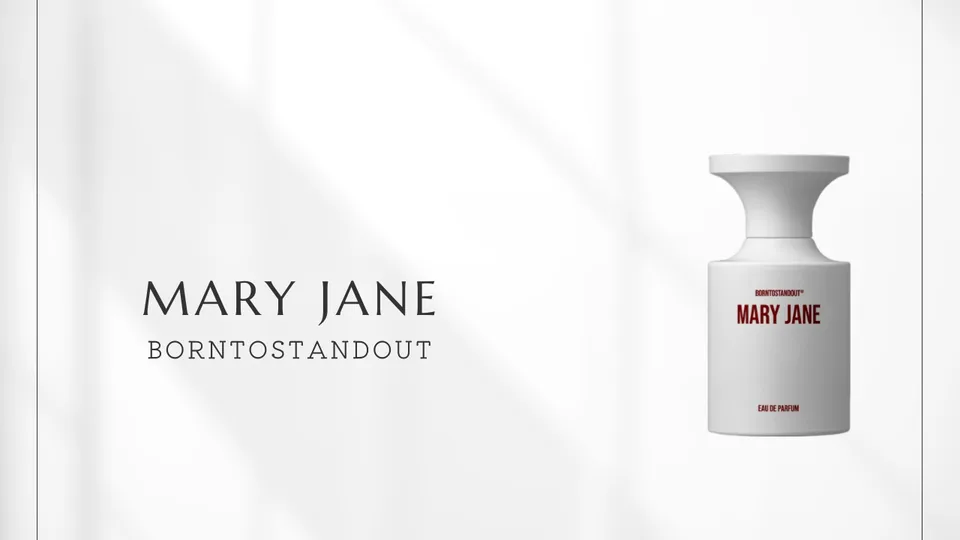
The bottle is opaque white glass with a weighty cap and crimson typography, drawing on the form of Korean white porcelain while deliberately disrupting its associations with purity. Listings and pricing differ between markets, so check locally rather than assuming.
This is a fragrance to sample before committing to a bottle. The opening is intentionally severe, and rhubarb, passion fruit and caramel can shift the balance noticeably from one skin to another.
When It Works
Spring, early autumn and warm evenings give the green opening room to breathe while keeping the caramel base in check. Outdoors it reads as bracing and unusual; in a small conservative office, the combination of mint, cannabis and sugar can feel more conspicuous than the bottle suggests.
Casual, creative settings suit it best: festivals, outdoor parties, weekend wandering, or any occasion where a deliberately strange fragrance feels welcome. It is less convincing when you need something unobtrusive.
The contrast also changes with clothing. Against cotton or technical fabric, the mint and tart fruit feel brisk and almost fluorescent; against leather or a soft knit, caramel and cashmere wood become easier to notice. Neither effect makes the fragrance universally seasonal, but it gives you some control over which side of the composition you emphasise.
MARY JANE succeeds by refusing to settle into a single register. The frozen mint never becomes simple freshness, and the caramel never turns fully cosy. Choose it for that tension. If you want a photorealistic cannabis fragrance or a smooth gourmand, this is aiming elsewhere.