Tsujigahana
R fragrance’s Tsujigahana is a fruity green floral that moves from grape leaves and skin to wisteria and violet. Inspired by a decorated Japanese textile, it imagines a fragrance worn across boundaries.
#531 · 2026-11-01
Fragrance Overview and First Impression
R fragrance’s Tsujigahana is an eau de parfum that begins with grape leaves and skin. The brand describes it as a fruity green floral. Ylang-ylang and clove join the opening before the fragrance moves toward wisteria and violet. The grape reference reaches beyond sweet juice: the leaf and skin suggest a greener, slightly drier direction.
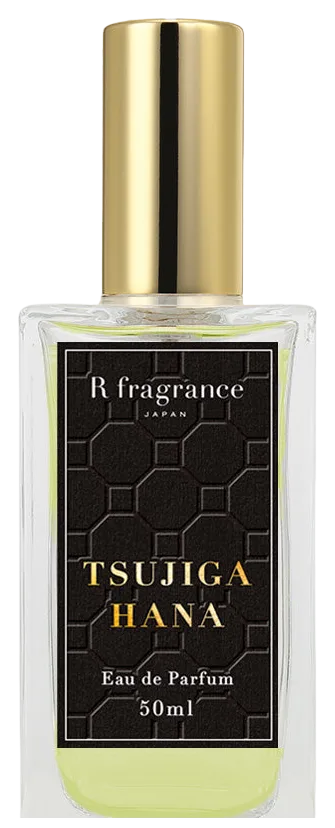
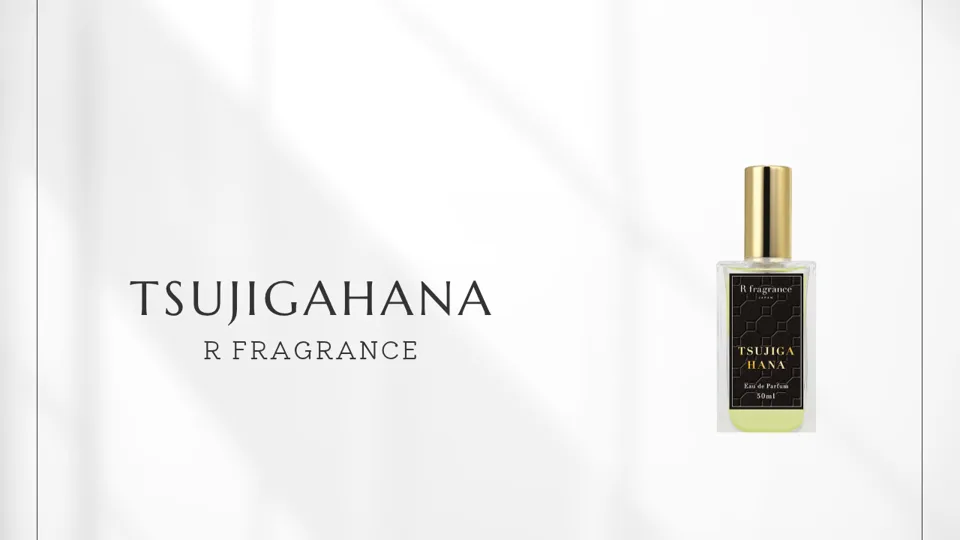
The bottle is a clear, square glass flacon holding pale yellow-green juice, topped with a gold cap. Its black front label is embossed with a geometric pattern of octagons and small squares, with TSUJIGA HANA in gold lettering. The outer box is black paper. The same octagon-and-square lattice appears large in gold on its front, along with the brand name and TSUJIGA HANA, also in gold.
The name refers to a form of decorated Japanese textile. The product description evokes a flower that blooms only on a kimono and mentions resist dyeing, gold leaf decoration and embroidery associated with Momoyama culture. Tsujigahana itself is a tie-dyeing technique that flourished from the late Muromachi period into the Azuchi-Momoyama period. Areas of cloth were stitched and bound to resist the dye, the binding was repeated for each colour, and the work was finished with ink painting, gold and silver leaf and embroidery. Production almost ceased in the Edo period, and fewer than 300 pieces survive, which is why it is called a “phantom dye”. The fragrance’s concept also imagines the scent worn across boundaries of gender and identity.
Perfumer, Brand and Creative Background
Chihiro Murai founded R fragrance and works as a perfumer. She became interested in fragrance at fifteen, studied materials and composition, worked for a fragrance company, and became independent in 2014. She launched the brand in March 2017. A retailer credits Murai for Tsujigahana, although the official product page does not carry an individual perfumer credit.
Murai’s stated interests include philosophy and the expression of emotions that cannot be seen directly. The letter R in the brand’s name carries three meanings in its own account: RIN, RICH and RARE. The textile reference in Tsujigahana places a specific Japanese cultural subject beside a fragrance intended for wearers without a fixed boundary.
Scent Analysis
The official structure has a top, middle and base. Grape leaves and skin appear at the top with ylang-ylang and clove. This combination leaves room for a green or slightly bitter impression alongside the fruit, while the flower and spice add other facets to the opening.
Wisteria and violet form the middle. Their softer, sometimes powdery floral impression changes the direction of the grape opening. Wearers differ in how closely this stage resembles living wisteria flowers.
Heliotrope, musk and sandalwood make up the base. They carry the composition toward a softer floral and woody finish. Some wearers describe the grape as juicy; others notice more of the leaf and skin. Trying the fragrance beyond its opening helps reveal which side is most prominent on a particular wearer.
Comparison and Positioning
Nishane’s Karagoz offers a useful comparison through grape. Tsujigahana moves from grape leaves and skin toward wisteria and violet; Karagoz pairs black grape with pineapple and bouquet garni, putting fruit and herbs further forward. Choose Tsujigahana for the turn toward flowers, or Karagoz for a more fruit-and-herb direction.
L’Occitane’s Glycine shares wisteria as a point of interest. In Tsujigahana, the flower follows a green grape opening and sits beside violet. Glycine places wisteria at the centre of a brighter floral idea with white peony and caviar lime. The grape-to-flower transition distinguishes Tsujigahana; a brighter wisteria focus distinguishes Glycine.
Parle Moi de Parfum’s Totally White / 126 also includes wisteria, presenting it among lilac, mock orange and hawthorn in the image of a Paris spring park. Tsujigahana brings grape leaves and skin before its flowers and draws on a decorated textile. The choice is between layered park florals and a greener movement into flowers.
Buying Guide
The official product listing identifies Tsujigahana as an eau de parfum and listed a 50 mL bottle at ¥19,800 including tax when checked. Prices and availability can change. Trying it on skin is especially helpful if the word grape raises an expectation of sweet juice: the listed leaves and skin may feel greener or drier. Follow the floral middle and the musk-and-wood base before deciding.
Wear, Settings and Impressions
Wearers find it easy to use for everyday outings and at the office. Some wearers also imagine it with traditional Japanese dress or understated clothing. These are suggestions and impressions, rather than a fixed dress code.
It suits spring best and also works as autumn cools. On humid summer days, the musk and sandalwood in the base may feel a little heavy. Wearers report different balances of juicy grape, green leaf, powdery flowers and the softer base. Tsujigahana’s central question on skin is how that green opening meets wisteria and violet; the answer gives more guidance than the textile name alone.