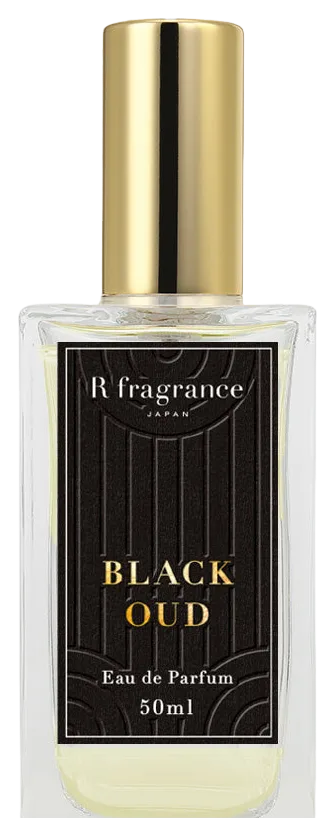
BLACK OUD
R fragrance's BLACK OUD moves from bergamot through a floral heart to a base containing oud and sandalwood. Its imagery draws on the gradations of ink painting and the restrained richness of a stone garden.
#504 · 2026-10-05
Fragrance Overview
BLACK OUD by R fragrance is a floral woody eau de parfum built around flowers and oud. Its name may suggest a dense, dark wood fragrance, yet the brand's description turns to the transparency created by flowing shades in an ink painting. The official structure begins with bergamot, passes through three floral notes, and ends with a base containing oud and sandalwood. That sequence gives the fragrance a more varied shape than its name alone suggests. The floral heart is a substantial part of the stated composition, rather than an incidental decoration around the wood.
The product page also places the Japanese characters for black agarwood beneath the English name. Oud is one of the listed base notes, while geranium, rose, and iris occupy the middle. Reading the note list in order offers a practical way to approach the scent: notice the citrus opening, then the flowers, then the woods. The listed stages describe the design, though they do not promise that everyone will perceive each note at the same strength or at the same moment.
The brand pairs the transparency of ink painting with the dignified presence of kyara in its description. Kyara is a prized kind of agarwood, and here the term conveys an artistic idea. The available product information does not establish that natural kyara is an ingredient. The picture of dark ink leaving space on the page helps explain the intended meeting of lightness and depth without turning that image into a claim about the formula.
Perfumer, Brand, and Creative Background
Chihiro Murai founded R fragrance and is responsible for the brand's fragrance planning, development, and composition. The brand says she enjoyed scented objects as a child and was drawn to perfume's beauty and expressive power when she first encountered it at fifteen. After formal study, she worked as a perfumer at a fragrance company and became independent in 2014. Murai's stated interests include human emotion, thought, and other subjects that cannot be seen directly. That interest offers a way to understand why a fragrance might be described through a visual art form or a philosophical idea.
Murai established her company in January 2017 and launched R fragrance that March. The letter R is associated with three ideas in the brand's account: RIN, a dignified bearing; RICH, richness of scent; and RARE, rarity. The brand seeks to express aspects of Japanese culture and offer a moment of pleasure through fragrance. BLACK OUD's references to a stone garden and ink painting sit within that broader approach. The dates describe the company and brand; the official product information does not give an individual launch date for this fragrance.
A stone garden uses a limited number of elements, such as rocks and sand, to suggest a larger scene. The BLACK OUD product description sees a kind of richness in retaining only what is needed. Ink painting likewise draws expressive range from gradations and open space. The brand places that transparency beside the solemn presence of kyara. These references describe the fragrance's concept rather than a specific garden or temple where its creation took place.
Scent Analysis
The name points to oud, but the official notes are arranged as a top, middle, and base. Bergamot is the sole listed top note. As a material name, it suggests bright citrus and a lightly bitter peel quality before the flowers and woods. The list does not tell us exactly how strongly it appears on skin or how long that opening lasts. It does, however, give a useful point of attention when testing a fragrance whose name might otherwise draw all attention to the oud.
Geranium, rose, and iris form the middle. Their familiar scent profiles offer different possible textures: geranium can be rosy and green, rose brings a floral center, and iris is often associated with dry powderiness. Those are ways to listen for the notes, not measured descriptions of their strength in BLACK OUD. Their placement helps explain the official floral woody classification. Instead of moving directly from citrus to dark wood, the listed composition gives flowers their own stage.
Amber, musk, oud, patchouli, and sandalwood appear in the base. Amber and musk suggest warmth and softness as general note qualities, while oud and sandalwood point to different woody textures. Patchouli can add an earthy shade. The note list does not identify the origin, amount, or extraction method of the ingredients used. What it establishes is the intended order: a citrus opening, a floral middle, and a later group of warm and woody notes.
Amber and musk deserve attention alongside the named woods. Their placement suggests that the base is meant to have more than one texture. The brand's idea of transparency can be read as a relationship between darker and lighter impressions, much as an ink painting retains both dense marks and open paper. The speed and prominence of each change may vary on skin. Allowing time for the floral heart and woody base to appear will give a better basis for choosing the fragrance than judging only its first spray.
Comparisons and Positioning
Opal Silk, another R fragrance perfume, shares rose and sandalwood with BLACK OUD in the available note listings. Opal Silk also lists yogurt, green grape, and incense, giving the two fragrances different combinations around those shared elements. Comparing them is useful if you want to see how the same brand approaches flowers and woods in two ways. In BLACK OUD, the route from bergamot through flowers to an oud-containing base remains the central distinction. The comparison concerns listed structures; it does not claim that the two wear identically.
Dior's Oud Ispahan also brings rose and oud together. Dior presents Damask rose and oud in a rich, forceful expression. BLACK OUD lists bergamot and iris as well and places the transparency of ink painting within its concept. If a pronounced rose and oud pairing is your main interest, Oud Ispahan offers one direction to try. If the idea of several flowers leading toward wood is more appealing, BLACK OUD gives you another. Testing both on skin is the fairest way to judge their actual weight.
TOM FORD BEAUTY's Oud Wood shares oud, sandalwood, patchouli, and amber with BLACK OUD in the cited note information. Oud Wood also lists cardamom, pink pepper, vetiver, and tonka bean, while BLACK OUD places geranium, rose, and iris in its middle. This makes the pair useful for comparing a spiced wood direction with a structure that leads through flowers. Shared note names alone do not establish similar performance or an identical scent; the different surrounding materials are the reason to try them side by side.
Across these comparisons, BLACK OUD's identity rests on more than the presence of oud. Its floral center, woody base, and stated ink-painting imagery work together. Whether that particular balance appeals to you is a better question to bring to a trial than whether it matches a general idea of a powerful oud perfume.
Buying Guide
The official product page listed a 50 mL eau de parfum at a tax-inclusive price of ¥19,800 when checked in October 2026. Check the official site for the current price and availability before purchasing. The available official information does not establish other sizes or concentrations. Anyone drawn to the name because they expect a dense oud should test the fragrance first, paying particular attention to the bergamot opening and floral middle.
Give the fragrance time after application. Geranium, rose, and iris are listed in the middle, and oud and sandalwood appear among the base notes. No reliable fixed number of minutes describes how quickly those stages appear on every wearer. What matters for a purchase is which part remains most noticeable to you and whether the balance of flowers and wood stays appealing on your skin. Testing beyond the first impression is especially useful here because the name emphasizes only one part of the composition.
There is a clear reason to try BLACK OUD if you enjoy floral notes such as rose or iris and are curious about oud. Its artistic references to a spare stone garden and an ink painting may also appeal to someone who enjoys a quieter idea of richness. Wearers often describe it as light for an oud, with a restrained presence. If strong projection or the weight of a dense oud is your priority, test it on skin before choosing.
Wearing Experience and Occasions
Wearers often describe BLACK OUD as light for an oud fragrance, with a restrained presence. The opening is clear on application, so some people start with a small amount. Longevity tends to be on the longer side, with wearers reporting roughly six to ten hours. Rather than spreading outward, it rewards attention to the overlap of flowers and wood close to your own skin.
Autumn and winter suit it best. It also fits a quiet evening at home or a workday when you want something discreet. Spring works too; in summer, use less and apply a small amount away from the body, such as at the ankles or below the knees. Many wearers also find it easy to wear regardless of gender. Paired with everyday clothes on a calm day and noticed at close range, it can bring the stone garden's open space and the ink painting's gradations to mind. It suits ordinary moments more than occasions that call for a strong entrance.
It is described as gentler than the density of many oud fragrances from overseas houses. How strong it feels and how it lingers on your skin are worth checking before buying. BLACK OUD's appeal lies between the depth its name suggests and its route through flowers toward wood. If that difference feels comfortable, it is an easy choice for a scent to enjoy quietly at close range.