Esprit de Contradiction
Esprit de Contradiction pairs fresh tangerine with warm cedar wood in a citrus and woody eau de parfum. Pepper, ginger and florals sit between those poles, giving the fragrance a changing texture that reflects Maison Matine’s idea of acceptance and assertion.
#502 · 2026-10-03
Fragrance Overview and First Impression
Maison Matine’s Esprit de Contradiction is a citrus and woody eau de parfum built around a contrast: fresh tangerine at one end and warm cedar wood at the other. The house connects that pairing with the ideas of acceptance and assertion. Pepper, other spices and florals fill the space between the bright beginning and the settled finish, so the first citrus impression tells only part of the story.
Introduced in 2019 among Maison Matine’s first six fragrances, it is listed on the official product page as a 50mL eau de parfum with a 20 percent concentrate. The brand describes it as unisex. Its official note list gives a useful path for testing: tangerine, citrus, black pepper and coriander at the top; ginger, ylang ylang, iris roots and clove in the middle; then musk, vetiver, sage and cedar wood in the base.
Perfumer, Brand and Creative Background
A retailer and a fragrance database credit Christian Vermorel as the perfumer of Esprit de Contradiction. The official product page names both Vermorel and Mathilde Purseigle, although the saved page text does not label their roles. In the published scent structure, the fresh tangerine opening and warm cedar wood base are connected by spices and floral materials.
Marie Kellou and Arthur Ponroy founded Maison Matine after working together at a creative company in Paris, according to the brand’s Japanese distributor. The house links its name to the Latin mutare, meaning to change, and says Matine also suggests morning light. It works with perfumers and graphic designers to give its fragrances both a scent and a visual identity.
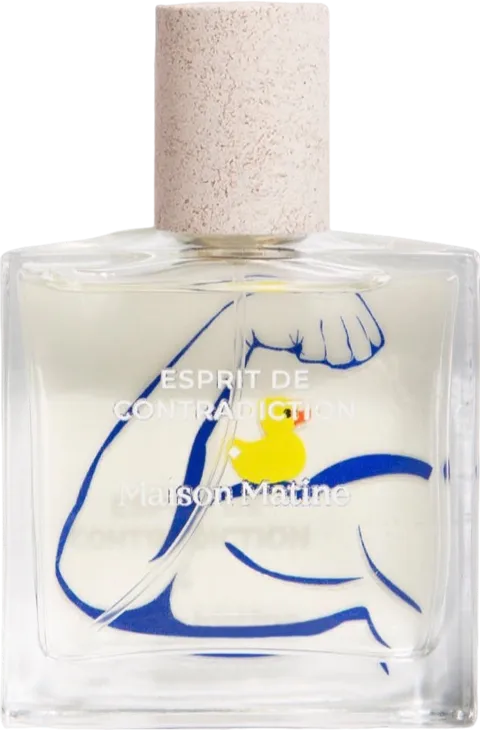
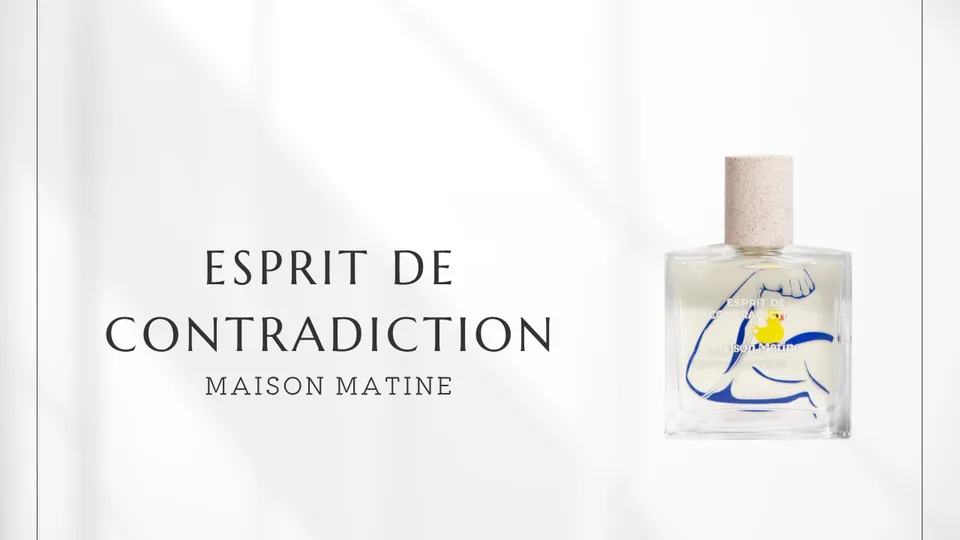
The bottle’s front shows a blue outlined arm flexing its muscle, with a yellow rubber duck perched above it. Retailers identify Mathilde Purseigle as a designer or illustrator associated with the fragrance. One wearer reads strength and gentleness in the pairing; the brand has not specified what the illustration means. The product page also describes recycled and recyclable packaging. In Japan, the distributor explained the title through the idea of a spirit of rebuttal directed toward clarifying one’s own identity. The brand’s pairing of tangerine and cedar wood gives that idea a concrete sensory form.
Scent Analysis
The fragrance is presented in three stages: top, middle and base. The top lists Tangerine, Citrus, Black Pepper and Coriander. Tangerine supplies the fresh, bright side of the composition. With Black Pepper and Coriander alongside it, the opening carries spice as well as fruit.
When trying the pairing of Tangerine and Citrus, notice how the prickle of Black Pepper enters alongside their juicy impression. Coriander is also part of the top. Several materials arrive together from the start, so follow the scent beyond its citrus opening to catch what comes next.
The middle lists Ginger, Ylang Ylang, Iris Roots and Clove. Ginger and Clove carry the spicy thread forward, while Ylang Ylang brings a floral note and Iris Roots another texture. Together they give the passage from bright citrus to warm wood a character of its own.
Here, Iris Roots names the root note shown in the list. Its character can be considered beside the floral impression of Ylang Ylang to reveal more variation within the middle. Some wearers notice Ginger after the citrus; others notice a pale floral or powdery quality first. Testing on skin shows which material comes forward.
The base lists Musk, Vetiver, Sage and Cedar Wood. The brand sets the warmth of Cedar Wood against the freshness of Tangerine. With Vetiver and Sage also present, the finish has more than one aspect of wood. Following the combination through to Musk brings the fresh opening and warm finish into one composition.
Follow the first citrus, then the spice and flowers, and finally the wood, without assigning a fixed minute to each change. On skin, that sequence reveals the materials between Tangerine and Cedar Wood as clearly as the contrast at either end.
Comparison and Positioning
Chanel’s ALLURE HOMME is an eau de toilette that shares mandarin citrus, coriander, black pepper and cedar with Esprit de Contradiction. Their woody finishes differ. Tonka bean and labdanum give ALLURE HOMME a sweeter, warmer base; sage, vetiver and musk accompany the drier wood impression of Esprit de Contradiction.
Cartier’s Declaration Eau de Toilette also combines citrus with coriander and pepper. Ginger, iris roots, cedar and vetiver offer further points of comparison. Cardamom, birch, leather and tea take Declaration toward dry spice and leather, while tangerine and ylang ylang give Esprit de Contradiction a brighter, softer character.
Maison Matine’s Nature Insolente is a citrus and floral fragrance from 2021. Like Esprit de Contradiction, it moves from citrus toward vetiver, cedar and musk. Lily of the valley, mint and honeydew melon in its middle give Nature Insolente a greener, juicier direction.
Choose Esprit de Contradiction for citrus and spice followed by dry wood, ALLURE HOMME for a sweeter, warmer woody finish, Declaration for dry spice and leather, or Nature Insolente for greener, juicier citrus.
Buying Guide
The official product page lists a 50mL eau de parfum and describes a 20 percent concentrate. A retailer has also listed a 15mL version of the same fragrance, while Maison Matine offers a discovery set containing this scent among eleven 2mL samples. The smaller bottle serves a different purpose from the set: one is a way to carry the fragrance, while the other lets a wearer compare it with the rest of the collection.
The official European product display showed 65 euros for 50mL when checked for the research. Prices in Japan have appeared at different levels and at different times, so current seller information is the appropriate basis for a purchase. Sampling beyond the tangerine opening matters more than reading the title alone. The later woods, spice and soft floral texture will determine whether a full bottle suits the wearer.
Someone who enjoys fresh fruit alongside pepper and warm wood has a clear reason to try it. Someone seeking only a light citrus should first check the middle and base; someone seeking an immediate deep wood should pay attention to the brightness and pepper at the start.
Wearing Experience and Occasions
Some wearers find Esprit de Contradiction especially light and easy during spring or summer days. Work and casual situations also appear in user impressions. A shirt or light outer layer suits that daytime context, while an autumn daytime test can help judge how the scent feels in cooler air. A retailer suggests year round and day or night use, though the wearer reports in the research most clearly describe the lift of a spring or summer day.
People notice different parts of the same note list. One may enjoy the meeting of citrus, black pepper and ylang ylang; another may first register a pale flower or powdery texture. Some describe the path through ginger toward wood. Smelling once at application and again after the opening settles is more useful than expecting every listed material to appear separately.
Wearers differ on longevity: some find it short lasting, while others notice it for longer. Testing on one’s own skin shows both how long it lasts and the distance at which it remains noticeable. The deciding pleasure may be the bright tangerine, the textured middle, or the warmth of cedar wood at the end.