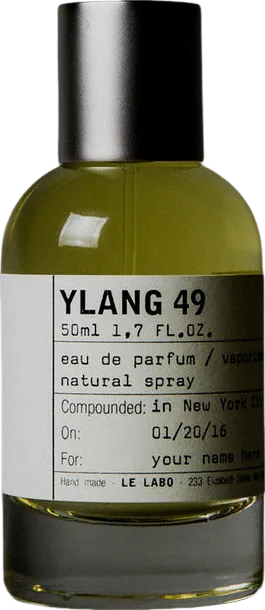
YLANG 49
Le Labo’s YLANG 49 is a chypre floral that layers lush ylang ylang and Tahitian gardenia over patchouli, oakmoss and dry woods. Its forest bouquet evokes the overlapping melodies of a Bach fugue, while its balance of flowers and moss can vary considerably on skin.
#493 · 2026-09-24
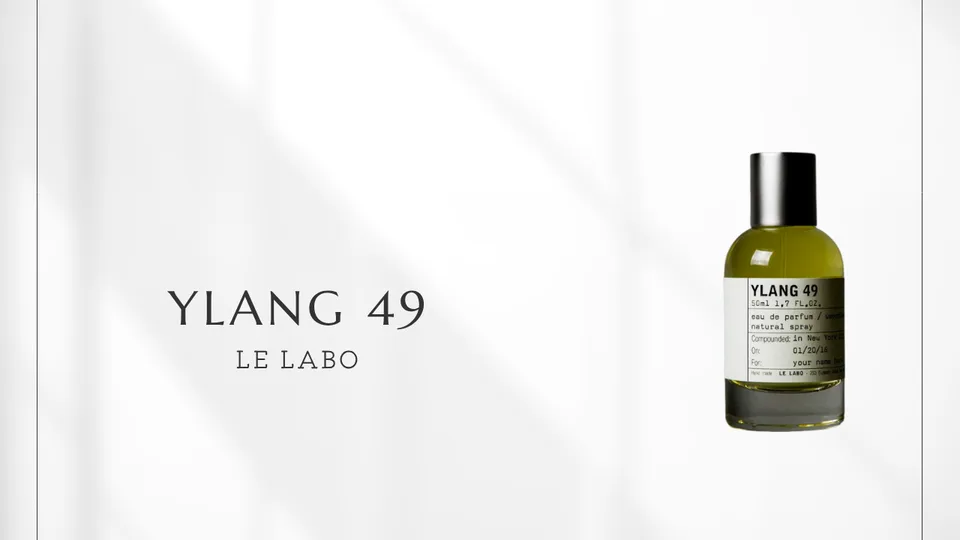
Fragrance Overview and First Impression
Le Labo's YLANG 49 is an eau de parfum introduced in 2013. It is a chypre floral: lush ylang ylang and Tahitian gardenia sit over a dark base that suggests moss and wood, giving the scent a depth that goes beyond bright flowers alone. The number in a Le Labo fragrance name is said to indicate how many raw materials are used in the scent.
First impressions vary considerably from skin to skin. Some feel the richness of ylang ylang and gardenia most strongly, while others notice the deep green of patchouli, the bittersweet edge of oakmoss, or dry woods early on. If you expect only sweet, bright flowers, the darkness of moss and roots may surprise you—and that contrast is exactly what gives this scent its character.
The bottle is a simple glass bottle with an applied label. At Le Labo, customers can also have a name or message printed on the label when they buy.
Perfumer, Brand, and Development
The perfumer is Frank Voelkl. Born in Germany, he says the smells of his uncle's farm and of rain remain among his earliest scent memories. He became interested in perfume while spending his teenage years in Paris, studied at the perfumery school ISIPCA, and then joined the fragrance house Haarmann & Reimer.
Tiare is a white flower that symbolizes Tahiti. In 1997, Voelkl created a fragrance built around tiare, and he has said that his connection with his wife, who is from Tahiti, sparked his interest in the flower. He had been working with tropical flowers long before YLANG 49.
In a 2013 interview, a Le Labo co-founder explained that the brand tried several floral directions for about two years without being able to settle on one, and in the end released LYS 41 and YLANG 49 together as a pair of new fragrances with different directions.
The brand name Le Labo means "laboratory" in French. It was founded in New York in 2006 by Édouard Roschi and Fabrice Penot, with its first store reportedly in Nolita. The brand emphasizes careful handwork and taking time to make fragrance, and it was reported to have joined Estée Lauder in 2014.
Detailed Scent Analysis
The heart of the scent is ylang ylang and Tahitian gardenia, which in Tahiti is called pua noa noa. Ylang ylang is a sweet, dense, creamy tropical flower, and the gardenia adds a sweet, full-bodied white-floral character.
Five materials—patchouli, oakmoss, vetiver, sandalwood, and benzoin—layer over the flowers as a dark, sensual base. The seven materials are not presented as a top, middle, and base sequence but as a combination of flowers and base. When wearing it, rather than asking which note comes first, it is easier to understand the scent by noticing how the flowers, moss, and wood overlap on the skin.
The official product page describes the fragrance through two images. One is walking through a forest while holding a lush bouquet of flowers. The other is a piece by Bach, comparing the scent to music in which one melody layers over another to build depth. The brightness of the flowers, joined by moss and wood into a single whole, is the structure of YLANG 49.
Comparisons and Positioning
The natural comparison is LYS 41 from the same brand, launched at the same time in 2013. Reviews at launch contrasted LYS 41, where white flowers come to the front, with YLANG 49, a chypre in which oakmoss and patchouli overlap the ylang ylang. If you want the brightness of white flowers, LYS 41 is the choice; if you want flowers with the shade of moss and wood, YLANG 49 fits better.
One review from the launch period described YLANG 49 as an "urban cousin" of Les Nez's Manoumalia. Manoumalia is also rich in tropical flowers, while YLANG 49 is portrayed as a more urban chypre tightened with moss and vetiver.
Other fragrances are also mentioned alongside it. Clinique's Aromatics Elixir is compared as a powerful floral chypre with moss, patchouli, and an herbal firmness. If you want white flowers layered with moss and bitter woods, YLANG 49 is the pick; if you want a more herbal, firmer chypre, Aromatics Elixir is a candidate.
With Yves Saint Laurent's Rive Gauche, reviewers point to a shared powdery soap impression and a note like freshly cut green stems. Rive Gauche is a clean, soap-like floral, while YLANG 49 suits those who want the dryness of moss and wood beneath the flowers.
Buying Guide, Price, and Suitability
Prices are ¥990 for the 1.5 ml discovery size, ¥14,300 for 15 ml, ¥32,230 for 50 ml, and ¥47,190 for 100 ml. You can start with the 1.5 ml size and then choose a larger bottle based on how often you wear it. Prices may change, so check the latest information before buying.
For carrying it with you, there is also a travel tube set of three 10 ml sprays.
There is no gender designation. It is best chosen by whether the combination of flowers and moss suits your taste. It is worth trying for anyone drawn to chypres with rich flowers and moss, while those who dislike strong patchouli may feel more comfortable testing a small size on skin first.
Wearing Experience, Settings, and Reception
Many wearers find it easiest to match with cooler weather, such as spring, autumn, and winter. In summer, a lighter application on a cool evening works better than the heat of midday.
For roughly the first hour the projection is strong, and after that it stays closer to the skin for a long time. In one detailed wear test, the projection eased after about four hours and settled into a skin scent at around eight hours. Some wearers report it lasting more than half a day, and some feel it faintly remained until the next day. Some love its rich flowers and moss, while others find the freshly applied intensity or the strength of the patchouli too much. Impressions also vary, from dry moss and creamy flowers to a soap-like facet.
In humid conditions, however, one wearer found it had faded considerably after about two hours, so longevity depends on the climate. Some also say a scent they disliked on paper turned more floral on skin, so testing on skin rather than a blotter is recommended. It pairs easily with calm outfits such as jackets and wool in cooler seasons.
Beyond the skin, some wearers say it lingered on clothes the next day, or on a pillow three days after spraying. It suits evening outings where the scent can take center stage, or going out on cool days. In settings that call for consideration of others—meals, the workplace, or public transport—a lighter application is the safer choice.
If you are concerned about strength, start with a small amount and compare how it smells right after application and a few hours later.