BAIE ROSE 26
A Chicago City Exclusive that layers bright pink pepper and clove with rose, dry cedar, and soft musk in a fragrance shaped by jazz.
#477 · 2026-09-08
Basic Information and First Impression
Le Labo BAIE ROSE 26 is a 2010 Eau de Parfum and the City Exclusive associated with Chicago. The French expression baie rose means pink pepper, so the name contains its central surprise: this is not a rose fragrance built on floral sweetness alone.
Pink pepper and clove give the first impression a bright, dry prickle. Aldehydes can feel cool and sparkling, while rose absolute brings denser petals. Cedar and musk add dry wood, softness, and a slightly powdery skin-like finish.
Le Labo frames the composition through Chicago jazz. Sharp pepper corresponds to an upbeat side, while the softer background suggests music that is spare and comforting. The fragrance holds those different tempos inside one spicy rose.
Perfumer, Brand Background, and Creation Story
Multiple independent sources credit BAIE ROSE 26 to Frank Voelkl. Born in Germany and raised partly in the Netherlands and France, he remembers the pungent smell of a barn and the air after rain at his uncle's farm. He studied chemistry and attended ISIPCA before beginning his career in Germany and later moving to New York.
Voelkl works across expressive niche fragrance and large international projects. He has described his aim as creating an emotional connection through scent, and dsm-firmenich appointed him Master Perfumer in 2026.
At launch, the story also invoked Prohibition-era Chicago, speakeasies, and jazz continuing through the night. The current brand account keeps the clearest idea: the city is represented through a contrast between brisk pepper and a gentler musical background.
Detailed Scent Analysis
Le Labo lists six key notes without assigning them to a top-heart-base pyramid: pink pepper, clove, cedar, aldehydes, an everlasting rose absolute from Grasse, and musk. They are best read as the main materials of the composition rather than a promised sequence.
Pink pepper feels bright and sharply spicy, while clove adds dry warmth. Some wearers describe the opening as cool, sparkling, or almost effervescent, with fine pepper defining the edge of the rose.
Aldehydes contribute a white, cool brightness. Beneath it, cedar can feel dry and low in sweetness. The contrast keeps the floral centre clear rather than lush or syrupy.
The Grasse rose absolute supplies petal density. Musk adds a softer, powdery, skin-like quality. Wear reports often describe bright spice first, a fuller rose through the middle of perception, and dry cedar with musk closer to the skin later, though the brand does not publish a fixed timetable.
Comparison and Positioning
Le Labo Rose 31 is the first useful comparison. Both combine rose with spice, cedar, and musk instead of presenting a purely sweet flower. Rose 31 places more emphasis on dry, earthy spice through cumin. BAIE ROSE 26 is brighter and cooler through pink pepper and aldehydes.
Le Labo MUSC 25 is another City Exclusive and also uses aldehydes and musk. MUSC 25 centres a contrast between pale cleanliness and darker materials such as vetiver, ambergris, and vegan civet. BAIE ROSE 26 instead keeps pink pepper, clove, and rose at the centre. The choice is between a study of musky light and shadow and a rose shaped by bright spice.
Buying Guide, Price, and Recommendation
BAIE ROSE 26 is sold as one Eau de Parfum rather than a group of concentrations. The Japanese official listing gives 1.5 mL at ¥1,760, 15 mL at ¥22,990, 50 mL at ¥52,250, and 100 mL at ¥76,560. Prices and stock can change and should be checked on the official site before purchase.
The Chicago lab sells the fragrance year-round. Elsewhere, samples are available online in August and September, and full sizes are sold online in September. For 2026, the Japanese official page gives a full-size sales window from 1 to 30 September. The 50 mL and 100 mL bottles can be refilled online year-round, and participating labs offer selected refill sizes throughout the year.
A 1.5 mL sample is the practical starting point for checking how strongly the pepper and rose appear on skin. The 15 mL size is easy to carry, while 50 mL and 100 mL suit longer use with refilling.
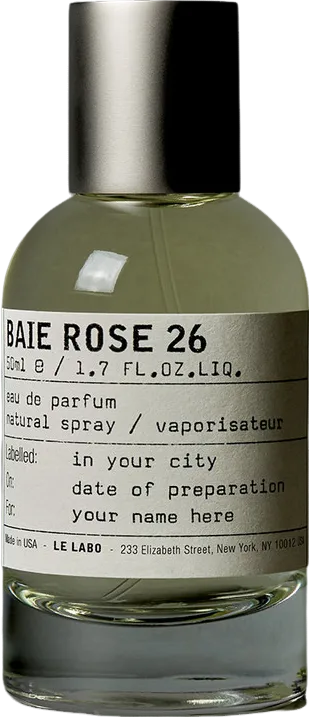
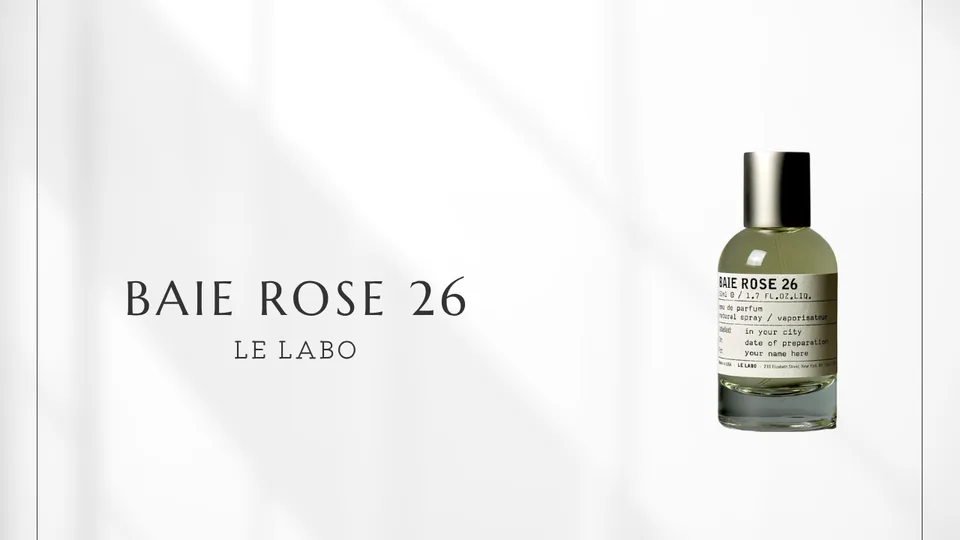
The clear cylindrical bottle uses a silver cylindrical cap and a white typewriter-style label. Fields record the fragrance, volume, place and date of compounding, and the buyer's name. The shared laboratory-like form lets the label and the fragrance distinguish this Chicago edition.
Wearing Experience, Scenes, and Reception
Spring and autumn are the clearest starting points. They allow the cool brightness of aldehydes and pink pepper and the warmth of rose and clove to remain distinct. In summer, wait until the heat has eased in the evening and begin with a small amount, because clove and dense rose can feel stronger in high temperatures.
Daytime outings, dinner, and a quiet jazz bar are natural settings. Clean shirts, light jackets, and simple knitwear suit its crisp floral-spicy outline. The balance of rose and pepper does not need to be assigned to one gender.
Wear reports differ substantially. Some people find the scent fades quickly, while others notice it for many hours or on clothing the next day. Projection is also described as strong at first by some wearers and close to skin later by others. In an office or on public transport, start with one spray and wait several hours before adding more.
One wearer may notice a cool morning rose, while another finds the opening spice intense. The deciding point is how the sweet petal density and fine pepper divide on your own skin, and whether the dry cedar and soft musk remain comfortable at close range.