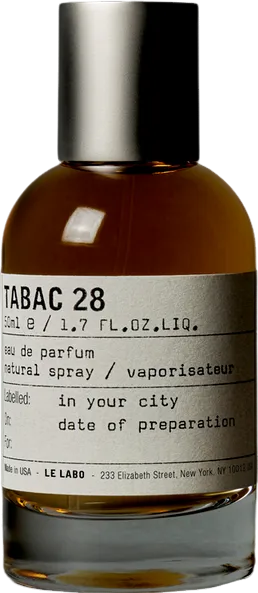
TABAC 28
Le Labo TABAC 28 layers dry cigar leaf and charred woods with the heat of rum and a cool flash of green cardamom. This Miami City Exclusive favors realistic smoke over a sweet tobacco accord and feels most at home after dark.
#459 · 2026-08-21
Basic Information and First Impression
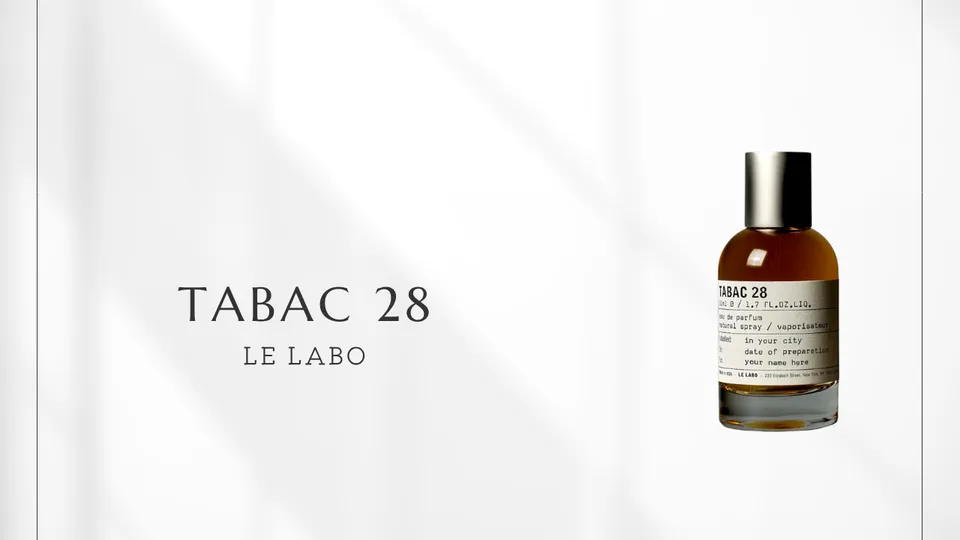
Le Labo introduced TABAC 28 in 2019 as the City Exclusive for Miami. It is an Eau de Parfum, and the house describes it as “Miami in a bottle.”
Yet this Miami is not painted with blue water, white sand, or a bright citrus breeze. Its six key notes are tobacco absolute, oud, cedarwood, gaiac wood, rum, and green cardamom. Dry cigar leaf, charred timber, the heat of liquor, and a cool green spice shape the city after dark.
In one line, it smells like a dry cigar bar with warmth left in a glass of rum. Unlike tobacco fragrances that lead with vanilla or cacao, TABAC 28 puts dry woods and low-burning smoke at the center. Its character is easiest to read when you want the bitterness of leaf and wood rather than a sweetened tobacco accord.
The way it is sold is part of the work. It is available year-round in Miami, while Le Labo releases the City Exclusives worldwide only during August and September. The fragrance is tied not only to a place, but also to the time and effort required to encounter it.
Perfumer, Brand Background, and Creation Story
TABAC 28 is credited to Frank Voelkl. Born in Germany, he spent part of his childhood in the Netherlands and France, studied at ISIPCA in Paris, and is presented by dsm-firmenich as a Master Perfumer.
Within Le Labo, Santal 33 and Thé Noir 29 are also widely credited to Frank Voelkl. TABAC 28 is therefore part of a longer body of work for the house rather than an isolated collaboration.
Le Labo was founded in New York by Fabrice Penot and Eddie Roschi and opened its first lab in 2006. Its name means “the laboratory” in French. The brand emphasizes freshly prepared fragrance in store and labels marked with the buyer’s name, place, and date. Even a City Exclusive keeps the familiar clear bottle, silver-toned cap, and plain white label, leaving the intensity of Miami inside a deliberately quiet object.
Detailed Scent Analysis
Le Labo does not divide the official notes into top, heart, and base. Six key notes overlap to create smoke, dry wood, alcoholic heat, and a green flash of spice. The scent changes on skin, but its materials should not be forced into a fixed time pyramid.
Tobacco absolute is the center. Le Labo asks us to imagine cigars distilled from Cuba or Havana: aromatic dry leaf and the smoke that lingers low after the ember has gone out. That image supplies the composition’s spine.
Oud and cedarwood make the tobacco darker and drier. Oud gives depth, while cedar draws a narrow grain through the structure. Together they smolder smoothly, rounding the fragrance with the inside of timber and its singed surface rather than with sugar.
Gaiac wood and rum add temperature. The rum is not a sugary cocktail; it is the warmth of spirits held inside dry wood. Gaiac wood turns that warmth toward smoke and lets it hover close to the skin.
Green cardamom supplies the final line of cool spice. Its small sharpness opens space inside the heavy tobacco and woods. A green glint keeps the dark composition from becoming flat.
Some wearers perceive an opening spark of rum and cardamom before the scent settles into dry tobacco and wood. Others find that tobacco and wood run straight through the entire wear. Reports also vary between long persistence and a scent that draws close relatively early, so skin testing matters more than any fixed schedule.
Comparison and Positioning
Maison Margiela Replica Jazz Club, covered in episode 51, shares rum, tobacco, and the atmosphere of a late-night bar. Jazz Club is an indoor bar rounded by vanilla and resin. TABAC 28 is the dry cigar bar after the crowd has gone, with less sweetness in the air and more charred timber left behind.
Tom Ford Tobacco Vanille, from episode 60, shows a different treatment of the same tobacco theme. Tobacco Vanille is a sweet cigar box built with vanilla and cacao. TABAC 28 is the room after the flame has gone out, where wood and smoke remain. The useful distinction is not sweetness alone, but cigar box as an object versus cigar bar as a space.
Le Labo GAIAC 10, covered in episode 76, is another City Exclusive. GAIAC 10 translates Tokyo through quiet woods and musk, while TABAC 28 gives Miami cigar leaf and rum. Both turn a city into scent, but the atmosphere of each city is markedly different.
Each comparison now has a distinct role: Jazz Club clarifies the late-night bar scene, Tobacco Vanille clarifies how tobacco is depicted, and GAIAC 10 clarifies the treatment of a city. Together they reveal the dry Miami at the center of TABAC 28.
Buying Guide, Price, and Recommendation
As of August 20, 2026, the Japanese prices were ¥1,760 for a 1.5 ml discovery vial, ¥22,990 for 15 ml, ¥52,250 for 50 ml, and ¥76,560 for 100 ml. Prices and sales periods can change, so check Le Labo’s current official listing before purchase.
The 1.5 ml discovery size is offered during August and September. Online sales of the 15 ml, 50 ml, and 100 ml sizes take place in September. The scent is available year-round in Miami, and the 50 ml and 100 ml bottles can be refilled throughout the year at Le Labo boutiques with a lab. These are sizes of the same City Exclusive Eau de Parfum; no alternate concentration was confirmed.
For a first encounter, start with 1.5 ml. Anyone expecting the sweetness of Tobacco Vanille may find the dryness and char stronger than anticipated. Test a small amount on skin and watch how the warmth of rum, green lift of cardamom, and dry woods remain over time.
It will suit people who enjoy low-sugar tobacco, charred timber, and the heat of rum, as well as those who value the limited encounter of a City Exclusive. If ash, cigarette paper, or scorching wood is an immediate dislike—or if you prefer light citrus and clean musk—a small sample will make the decision much easier.
Wearing Experience, Scenes, and Reputation
From its structure and wearer reports, TABAC 28 fits autumn and winter, dry evenings, and the time after dinner. Some people enjoy how its smoke behaves in summer humidity, but a hot day calls for restraint. Black, charcoal, and dark brown jackets, leather, and brushed fabrics continue its visual texture naturally.
Think of a post-dinner bar, a music or art venue, or a calm night out. It is less comfortable during a meal or in medical settings, small meeting rooms, and other places where people cannot move away from fragrance. Because tobacco and oud are dark and assertive, beginning with a small application preserves more detail than treating it like an airy fresh scent.
Positive reactions often mention the lack of excess sweetness, a realistic cigar impression, dry expensive wood, warmth from rum and cardamom, and a character that is not easily confused with other fragrances. Negative reactions describe an ashtray, cigarette smoke, burnt wood, too little rum sweetness, or a high price. Both attraction and discomfort come from the same dry-smoke core.
Imagine adding a color that can only be smelled to the vivid graffiti of Wynwood Walls. In Le Labo’s own terms, TABAC 28 may evoke Miami, but it does so through cigar smoke, rum, scorched wood, and a green flicker of cardamom—not through the sea. It is a city seen after dark, with the heat of the day still held inside wood.