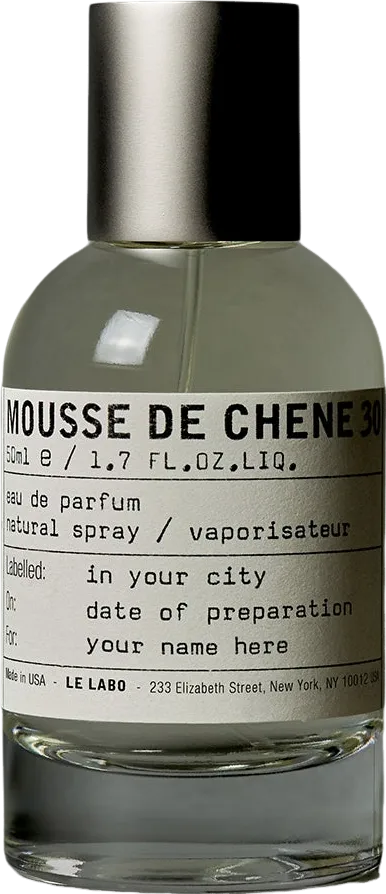
MOUSSE DE CHENE 30
Le Labo MOUSSE DE CHENE 30 is Amsterdam's neo-chypre, polishing moss and patchouli with crystal moss and Clearwood, then adding tension through three dry spices. Seven key notes, the city's dual character, and three comparisons reveal how the scent shifts between brightness and darkness on skin.
#452 · 2026-08-14
Basic Information and First Impression
MOUSSE DE CHENE 30 is Le Labo's Amsterdam City Exclusive, released in 2017 as an eau de parfum. The French name means oakmoss. It belongs to the house's city collection: available throughout the year in Amsterdam and, elsewhere, during the annual City Exclusives window.
The first impression is not the thick darkness of a classical moss-heavy chypre. Moss and patchouli form the center, but crystal moss and Clearwood sharpen and brighten their outline. Cinnamon, pimento bay oil, and pink pepper add dry heat and a clean prickle. Damp green, gray, and transparency seem to trade places on skin.
Le Labo describes a neo-chypre that is comforting yet surprising and tense, traditional yet progressive. That pair of opposites is linked to Amsterdam, where historic streets and contemporary design coexist at close range. The fragrance does not reject the older chypre framework; it moves that framework with newer materials.
Perfumer, Brand Background, and Creation Story
No individual perfumer is named in the official information verified for this fragrance. Rather than inventing an authorial story, the material roles provide the useful starting point. Moss and patchouli make the foundation. Crystal moss and Clearwood bring out their green and woody character with a cleaner edge.
Clearwood is a fragrance material with a clean woody and patchouli-like character. Supplier information says it can feel creamier when used more heavily. The exact amount used here is not public, but the material helps explain how earthy patchouli can move into smoother, clearer wood without losing depth.
The sales model adds another layer to the work. In Amsterdam it can become an everyday local scent; in other cities it appears only from August through September. Access is limited not only by place but by time, making the same bottle a permanent local object for one wearer and an annual encounter for another.
Detailed Scent Analysis
Le Labo does not publish a time-ordered pyramid for MOUSSE DE CHENE 30. Its official structure is a set of seven key notes: moss, patchouli, crystal moss, Clearwood, cinnamon, pimento bay oil, and pink pepper. Moss and patchouli sit low in the composition with damp green, earth, dry leaves, and wooden-floor textures. The result is less a literal forest than the idea of moss polished through contemporary materials.
Crystal moss and Clearwood push that central outline forward. Clearwood smooths some of patchouli's rough earthiness, allowing the green moss effect to feel more translucent. Some wearers experience this as clean and modern; others read it as a dark, concentrated chypre. Anyone expecting naturalistic forest depth may instead notice a more abstract, engineered cleanliness.
Cinnamon, pimento bay oil, and pink pepper do not form a sweet spice accord. They draw a narrow line of tension. Pink pepper and pimento can make the opening feel brisk, while cinnamon adds dry warmth. Citrus is not one of the seven notes, yet some wearers perceive a bright tartness or a dark citrus-like edge created by the interaction of spice and wood.
On skin, the opening may therefore feel brighter and spicier, the middle more earthy with damp green patchouli and moss, and the later phase smoother, woody, and translucent. This is an observed wearing arc, not an official top-heart-base claim. Following that distinction preserves both the official structure and the useful experience of change over time.
Comparison and Positioning
Comme des Garçons 2 also uses patchouli, wood, and spice to describe earth and light through modern materials. Its ink, incense, amber, labdanum, and aldehydes make the abstraction more graphic and smoky. Choose Comme des Garçons 2 for ink and incense; choose MOUSSE DE CHENE 30 for damp moss and transparent wood.
Frédéric Malle French Lover shares pimento, patchouli, dry woods, and an earthy surface. French Lover moves toward sharp green through galbanum, angelica, and juniper, then dries with incense and white musk. MOUSSE DE CHENE 30 emphasizes moss, cinnamon warmth, and the clarity of Clearwood. The former is the drier aromatic green; the latter feels like green after rain.
Hermès Terre d'Hermès Eau Givrée connects spice, wood, and transparency in another way. Citron, juniper berry, Timur pepper, and a mineral woody base create an icy, sharply lit profile. Choose Eau Givrée for frozen citrus and minerals; choose MOUSSE DE CHENE 30 for soil, moss, patchouli, and cinnamon warmth.
Together, these references locate the Amsterdam fragrance clearly. It is neither an ink-and-incense abstraction, a dry aromatic green, nor an icy citrus mineral scent. It is a damp moss structure moved into the present by transparent wood and taut spice.
Buying Guide, Price, and Recommendation
The Japanese official page listed four sizes for the 2026 season: 1.5 ml at ¥1,760, 15 ml at ¥22,990, 50 ml at ¥52,250, and 100 ml at ¥76,560. All are the same eau de parfum; the 1.5 ml format is a discovery size rather than another concentration. Prices, inventory, and dates can change, so the official page should be checked again before purchase.
Amsterdam carries the fragrance year-round. Elsewhere it is offered during the City Exclusives period from August through September; the Japanese 2026 page stated a limited run through September 30. For a first encounter, the discovery size is the practical choice because it reveals whether the spice feels bright and whether the moss becomes transparent or dark on a particular skin.
The 50 ml and 100 ml bottles can be refilled throughout the year at Le Labo locations with a functioning lab. The clear cylindrical bottle uses the house's restrained gray label and metallic cap. The City Exclusive identity comes from the scent and its place of sale rather than decorative packaging.
This is most suitable for someone who enjoys clean woods, earth, patchouli, and dry spice under tension. Someone seeking sweet moss, literal forest depth, or consistently quiet projection should test before buying. Wait beyond the bright opening until the wood and moss settle; that later balance is the most reliable basis for a decision.
Wearing Experience, Scenes, and Reception
The moisture and warmth of moss, patchouli, and cinnamon suit autumn and winter evenings as well as spring after rain. Old buildings, museums, dinner at night, and quiet workspaces complement it. Gray, black, white, and deep green clothing lets the calm woody base and the fine line of spice extend into the silhouette.
Humid summer weather can make this fragrance feel heavy, so it is better to hold off and wait for autumn or winter. Aggregated ratings suggest stronger persistence and projection, yet individual reports range from lasting until the next morning to becoming close to skin after roughly six hours. In close spaces, avoid stacking sprays before the fragrance has settled into wood and moss.
Positive responses often focus on a moss-and-patchouli scent that remains modern and unexpectedly clear: moss after rain, dry spice, polished wood, and a clean chypre outline. Negative responses tend to focus on the engineered moss effect, which can suggest shampoo or an impersonal synthetic wood.
Bright or dark, expansive or close to skin: the fragrance does not resolve into one universal reading. Like the comfort and tension, tradition and progress that Le Labo associates with Amsterdam, it can move in two directions on the wearer. Testing that range with a modest application is the surest way to understand MOUSSE DE CHENE 30.