SHIU 25
Le Labo SHIU 25 is the 19th City Exclusive, dedicated to Beijing in 2026. The name refers to the very wood at the centre of the scent, a link the brand discloses itself. Rather than a top-middle-base pyramid, it is built as a vertical arrangement with iris and frankincense floating above warm wood — a composition of dry timber and resin.
#439 · 2026-08-01
Basic Information and First Impression
SHIU 25 is the 19th fragrance in Le Labo's City Exclusive Collection, dedicated to Beijing and released in 2026. It comes only as an Eau de Parfum; there are no alternative concentrations.
In one line, it is a dry woody built from wood and resin with a deliberately small palette. Sweetness and creaminess are almost absent. Databases file it under Oriental Floral and retailers under Floral Amber Spicy, but rather than flowers or sweetness, what covers the whole composition is the dry air of wood.
The name is the interesting part. SHIU refers to the very wood at the centre of the scent. The brand writes that the fragrance is "built around shiu, the ho tree's quieter expression," disclosing the link between the name and its main material. Naming a fragrance after its principal material is routine for Le Labo, which pairs a key note with an ingredient count; what sets this one apart is that shiu is a word few people outside the trade would recognise, so the route to that wood is a step longer.
There is a second reading. Some point out that shiu is an old pronunciation of the Chinese character for "tree." The brand has not confirmed it, but the two readings do not contradict each other. One is the name of a raw material, the other the old sound for wood itself. Either way you arrive at the same tree.
Perfumer, Brand Background and Creation Story
The perfumer has not been disclosed. Le Labo places the house's overall olfactory aesthetic and the collaborative work of its labs ahead of individual perfumer credits.
The brand began in 2006, founded in New York by Fabrice Penot and Edouard Roschi. The two met at Giorgio Armani and developed the idea of slow perfumery in Grasse, France. They started without advertising and without outside investment, building the house around the experience of hand-compounding each fragrance in store. Estée Lauder Companies completed its acquisition in 2014, though the founders have retained creative independence. In 2026 the brand marked its 20th anniversary, and this release falls on that milestone.
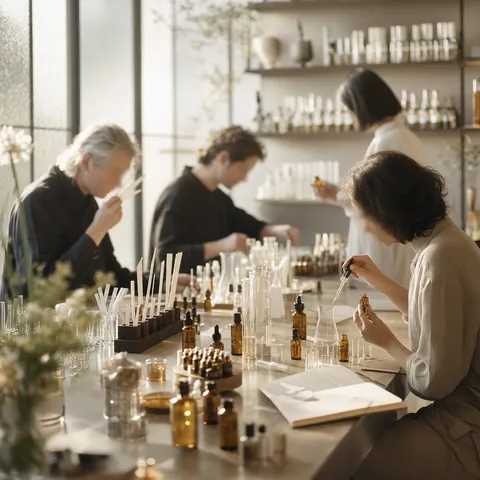
The home of this scent is the Beijing Heyuan Fragrance Lab, opened in 2025 inside a protected historic building known as No. 19 at WF Central. It is a siheyuan courtyard house restored from a Qing dynasty royal residence, combining traditional Chinese domestic architecture with the wabi-sabi aesthetic Le Labo has long pursued. The official inspiration reads the same way: shadows dancing on well-worn wooden floors, hidden gardens, sacred silence. This is a fragrance that tries to move the air of a shop into a bottle.
The lab contains a room called Qi Shi, a selection counter modelled on the herb drawers of a traditional Chinese pharmacy. It is designed to echo the gesture of weighing herbs on a scale and wrapping them in paper.
Detailed Scent Analysis
A caveat first: Le Labo does not publish top, middle and base pyramids. This release is no exception. What the brand describes is not a sequence of stages but a vertical arrangement — warm, anchoring woods below, with iris and olibanum floating above. Le Labo calls this an "intentionally compact composition," stating outright that the restraint is the point.
What stands first, in the position a top note would occupy, is the dry resin of frankincense. Wearers report that it is present from the very start, unlike the familiar pattern of a top note clearing to reveal resin. It reads as the dry sheen of freshly varnished wood.
In the middle position sits iris. The brand calls it "ethereal." It is not the sweet, lipstick-and-baby-powder kind; reviewers describe it as mineral, hard-edged and dry. One who tested it wrote that it was surprisingly dry, with none of the juiciness that usually rounds a fragrance out.
At the base sits shiu, or ho wood, a material from the camphor laurel family. The sharp, nose-prickling note most people associate with camphor is not what comes forward here. It is dry, slightly cool, with a transparent softness — the air of freshly planed wood, or a wooden box that once held camphor. That said, heat and humidity can push it toward something more medicinal.
This wood became widely used in perfumery because of rosewood. Overharvesting reduced supplies, and a substitute was needed. Ho wood contains a high proportion of linalool, giving a woody material a floral softness. That is why it could stand in.
The frankincense has been praised as the real thing, set apart from other City Exclusives. It reads less as smoke than as the surface texture of resin and timber.
The way it moves is unusual too. Rather than stages replacing one another, a small number of elements stay layered while only density and temperature shift. The stillness the brand speaks of is a matter of palette, not volume. That is the heart of this fragrance.
Comparison with Other Fragrances and Positioning
Placed beside other City Exclusives, the differences in direction become clear.
Kyoto's OSMANTHUS 19 paints the creamy sweetness of osmanthus against the texture of a machiya townhouse. This release holds sweetness back and leans into dry wood and resin. If you want floral sweetness, choose Osmanthus 19; if you want dry stillness, choose this one.
Tokyo's GAIAC 10 shares the meeting point of frankincense and wood. But where Gaiac 10 rests lightly against the skin like a second layer with gaiac wood and musk, this release adds the coolness of ho wood and the dry powder of iris, giving the scene sharper definition. For presence alone, Gaiac 10; for contour, this one.
The contrast with Shanghai's MYRRHE 55 maps onto two cities. Myrrhe 55 expresses Shanghai's complexity through myrrh and dense resin, while this release turns toward Beijing's courtyards and silence. If Shanghai is complex, enveloping resin, Beijing is stillness and the frame of wood. It is fascinating that one house divides China's two great cities this way.
Buying Guide, Price and Recommendation
Japanese prices are 22,990 yen for 15 ml, 52,250 yen for 50 ml and 76,560 yen for 100 ml. A 1.5 ml discovery size is also available. The 50 ml and 100 ml bottles can be refilled by bringing the empty bottle to a store.
Limited availability is the defining trait of this collection. It is normally sold year-round only in Beijing, and worldwide only from August through September. In Japan, discovery sizes run from 1 August to 30 September, with full sizes from 1 to 30 September. The brand states plainly that this is a limited run through 30 September 2026.
Because opinion divides on this scent, there is no reason to start large. Try the 1.5 ml first and follow it over several hours. If it suits you, the refillable 50 ml is the easier size to live with. Evaluation turns on whether you like dry wood and resin, so it is worth testing before deciding.
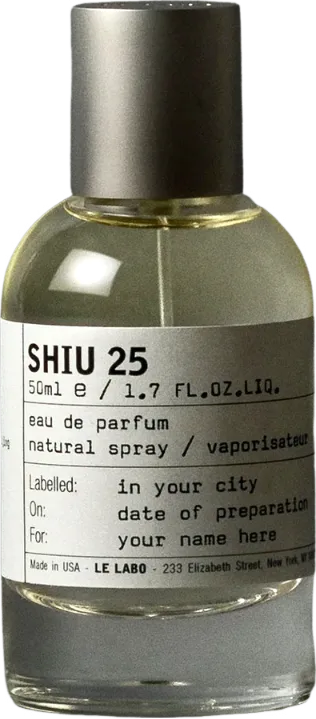
The bottle is Le Labo's standard cylinder, a minimal glass form recalling an apothecary jar. There is no bespoke bottle for this release. The label, however, records the place and date of compounding along with the buyer's name. Refilling does not retire the bottle; only the labels accumulate. That mechanism sits well with a fragrance whose theme is worn wooden floors and long-continuing craft.
Real-World Wear, Occasions and Reception
Autumn suits it best. Dry wood, resin and the powderiness of iris settle naturally as temperatures fall. Quiet spring days work too, and the warmth of the resin holds up indoors in winter, though this is not a thick, sweet winter scent and it may feel faint outdoors in real cold. In midsummer or high humidity the resin can turn heavy and the camphor medicinal, so it is worth using less.
For places: museums, bookshops, galleries. It suits reading, writing, and time spent alone in concentration. What to watch is the dinner table, along with cramped transport and medical settings, where resin and camphor can interfere with food or suggest a compress.
Distance may be the real pitfall. One wearer who applied four or five sprays felt it as faint and intimate, yet was told by others that it carried strongly even at normal conversational distance. It looks quiet, but it is not a fragrance that fails to reach. Start with about two sprays and follow it for several hours. Adding more because your own nose has stopped registering it is best avoided.
Longevity has no settled consensus yet, given how recent the release is. Projection is described less as filling a room than as the kind of quiet trail that makes someone pause. Opinion divides over the camphor, between those who find it serene and those who find it medicinal. If the texture of dry wood and resin appeals to you, this is worth waiting for September.